Small business website cost in 2026: what to budget


A small business website typically costs a range of a few hundred dollars to tens of thousands to build, depending almost entirely on who does the work. DIY builders like Wix or Squarespace run $10–$99/month with no upfront fee. A freelancer charges a few hundred to several thousand dollars for a basic custom site. A small agency starts at several thousand dollars and can reach tens of thousands for complex builds. Ongoing costs add several hundred to a few thousand dollars per year on top of whatever you paid to launch.
Here is where most small businesses land across the five common paths:
- SaaS DIY builder (Wix, Squarespace, Shopify): monthly fees with no upfront build cost
- WordPress DIY (self-hosted): initial and ongoing costs vary moderately
- Freelance custom build: moderate one-time cost, plus hosting and maintenance separately
- Small/boutique agency: costs vary from mid to high thousands one-time, with optional maintenance
- eCommerce agency/specialist: higher costs depending on catalogue size and integrations.
Website design pricing alone ranges from a few hundred dollars for a template to high five figures for full agency custom work, and design typically accounts for a significant portion of the total project cost. That single variable explains most of the gap between a $1,500 freelance quote and a $15,000 agency proposal.
Table of Contents
- What does a small business website actually cost? A fast reference
- What you are actually paying for: core cost components
- A detailed walk-through of each build path
- Ongoing and recurring costs to plan for after launch
- How to choose the right route and what to ask vendors
- How long will it actually take to launch?
- Three sample budgets with line items
- How managed services and automation can lower your lifetime website cost
- Key takeaways
- Why the cheapest build path is rarely the cheapest website
- What Tech Business Development’s packages cover and how to get started
- Sources and further reading
What does a small business website actually cost? A fast reference
| Build path | Upfront (low / typical / high) | Monthly recurring | Time to launch | Best for |
|---|---|---|---|---|
| SaaS DIY builder (Wix, Squarespace) | $0 / $0 / $0 | $17–$45/mo (plan + domain) | 1 day–2 weeks | Solopreneurs, brochure sites, fast launches |
| WordPress DIY (self-hosted) | $50 / $200 / $500 | $10–$30/mo (hosting + domain) | 1–4 weeks | Tech-comfortable owners who want flexibility |
| Freelance designer/developer | $500 / $2,500 / $5,000 | $15–$75/mo (hosting + maintenance) | 2–8 weeks | Growing businesses needing custom features |
| Small/boutique agency | $5,000 / $8,000 / $15,000 | $50–$200/mo (maintenance plan) | 6–12 weeks | Established businesses, lead-gen sites |
| eCommerce agency/specialist | $8,000 / $15,000 / $30,000+ | $100–$300/mo | 8–24 weeks | Retail stores, complex product catalogues |
A few caveats worth noting:
- SaaS builders like Shopify charge transaction fees (0.5–2% per sale on lower plans) that can outweigh the low monthly rate once revenue grows.
- WordPress DIY costs look cheap until you factor in premium plugins ($50–$300/year each) and the hours you spend troubleshooting.
- Agency quotes often exclude copywriting, photography, and SEO setup, which can add $1,000–$3,000 to the final invoice.
What you are actually paying for: core cost components
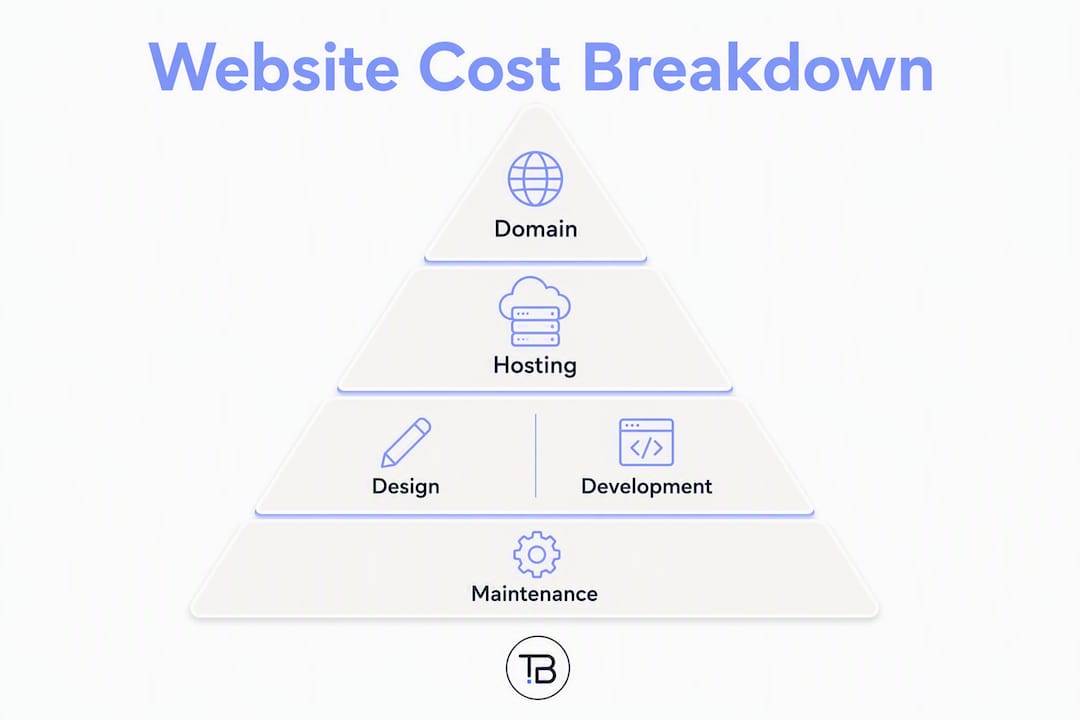
Every website quote, regardless of path, is built from the same underlying components. Knowing what each one costs lets you spot where a vendor is padding and where cutting corners will hurt you later.
Domain registration runs $10–$20/year for a standard .com through registrars like Namecheap or GoDaddy. Premium or short domains cost more, but most small businesses do not need them.
Hosting is where the range gets wide. Shared hosting starts at $3–$15/month and works fine for low-traffic brochure sites. Managed WordPress hosting runs $15–$75/month and handles updates, backups, and security automatically. SaaS builders bundle hosting into their monthly plan, so you never see it as a separate line item.
Design and development is the biggest variable. Template customisation costs $300–$1,500; semi-custom design $1,500–$5,000; freelance custom $4,000–$12,000; agency custom $8,000–$25,000+. Since design represents 30–45% of total project cost, this is the lever that moves your quote the most.
Here are the remaining components with typical 2026 price ranges:
- SSL certificate: free with most hosts (Let’s Encrypt) or $50–$200/year for extended validation
- Premium plugins/extensions: $50–$300/year each; a typical WordPress site uses 3–8 paid plugins
- Copywriting: $50–$150 per page; a five-page site adds $250–$750 to the budget
- Professional photography: $500–$2,000 for a half-day shoot; stock photos $0–$50/image
- CRM or booking integration: $0 (native tools) to $1,000–$3,000 for custom API work
- Payment processing: Stripe and Square charge 2.9% + $0.30 per transaction, not a build cost but a real ongoing expense
- Contingency: budget 10–20% on top of any quote for scope changes and unexpected expenses
Pro Tip: Ask any vendor to separate design hours from development hours in their quote. Design commonly accounts for 30–45% of the total, and seeing that split tells you immediately whether you are paying for craft or for code.
One hidden cost that rarely appears in any quote: your own time. A DIY builder is cheap in dollars but expensive in hours. If you value your time at $75/hour and spend 40 hours building and tweaking a Wix site, that is a $3,000 investment, not a $300 one.
A detailed walk-through of each build path
SaaS DIY builders (Wix, Squarespace, Shopify)
These platforms bundle hosting, SSL, templates, and a drag-and-drop editor into a single monthly subscription. Wix’s core business plans run roughly $17–$35/month; Squarespace’s business plans sit around $23–$65/month; Shopify starts at $39/month for its basic eCommerce plan.
At the low end, you spend a weekend building a clean five-page site with no outside help. At the typical end, you pay a freelancer $300–$800 to set up and style the template so it does not look like every other site on the platform. The high end involves third-party apps, custom code injections, and Shopify’s app ecosystem, which can add $50–$200/month in app fees before you know it.
The trade-off is control. These platforms are deliberately constrained. Migrating away from Squarespace later is painful; your content is locked into their system.
WordPress DIY (self-hosted)
WordPress itself is free. The cost is everything around it: a hosting plan ($3–$30/month), a premium theme ($50–$200 one-time), and the plugins that make it functional. A typical small-business WordPress build uses Elementor or a similar page builder ($59–$99/year), a security plugin, a backup plugin, an SEO plugin like Yoast, and a contact form plugin. Add those up and you are at $200–$500 in year one before you have written a single word of copy.
The real cost is maintenance. WordPress requires regular core, theme, and plugin updates. Skip them and you create security vulnerabilities. Hire someone to handle updates and you are paying $50–$150/month, which erodes the cost advantage quickly.
Freelance designer/developer
A freelancer is the right call when you need something that looks professional and works reliably, but you cannot justify agency pricing. Typical freelance builds run $500–$5,000 for a basic site, with most professionally built small-business projects landing in the $2,000–$8,000 range, according to industry pricing.

What you get at $2,000 is a template-based WordPress or Squarespace build with light customisation. At $8,000, you get a genuinely custom design, proper mobile optimisation, basic SEO setup, and a handoff session. Above $8,000, you are entering small-agency territory.
The risk with freelancers is continuity. If your developer disappears or raises rates, you are stuck unless you own the CMS credentials and understand the build. Always confirm asset ownership in writing before you pay a deposit.
Small/boutique agency
Agencies charge more because they bring a team: a project manager, a designer, a developer, and sometimes a copywriter. That coordination costs money, but it also means fewer surprises. Most web design projects reviewed on Clutch cost under $10,000, though the average across their full dataset is considerably higher due to large enterprise outliers.
A realistic small-agency engagement for a five-to-ten page lead-gen site runs $5,000–$15,000. That typically includes discovery, wireframes, custom design, WordPress or Webflow development, basic on-page SEO, and a training session. Copywriting and photography are almost always extra. Most professionally built small-business sites land in the $2,000–$8,000 range, with agency work reaching $15,000 or more for complex builds.
Agencies also offer ongoing maintenance plans, usually $100–$300/month, which cover updates, backups, security monitoring, and minor content changes.
eCommerce agency/specialist
Adding a store changes the economics entirely. Basic eCommerce features add $1,000–$5,000 to a custom build; advanced eCommerce with inventory management, custom checkout flows, and third-party integrations pushes costs to $5,000–$15,000+. A full Shopify or WooCommerce build from a specialist agency, with product photography, payment gateway setup, shipping integrations, and email automation, can reach $20,000–$30,000+.
Custom workflows, client portals, and CRM integrations are the single biggest cost driver in this category, more so than the platform choice or the designer’s hourly rate.
Ongoing and recurring costs to plan for after launch
The build cost is a one-time event. The recurring costs run forever, and they catch a lot of small-business owners off guard in year two.
Here is a numbered checklist of what to budget for annually:
- Domain renewal: $15–$25/year
- Hosting: $36–$900/year depending on plan type
- SSL certificate: $0–$200/year (free with most managed hosts)
- Plugin licences: $150–$600/year for a typical WordPress stack
- Theme renewal: $0–$89/year (many themes are one-time purchase)
- Professional email (Google Workspace or Microsoft 365): $72–$180/year per user
- Security monitoring and backups: included in managed hosting or $50–$150/year separately
- Content updates and technical maintenance: $0 (DIY) to $200+/month (managed plan)
- SEO and marketing tools: $100–$500/month if you use platforms like Semrush or run Google Ads
- eCommerce transaction fees: 0.5–2% per sale on Shopify’s lower plans; 0% on Shopify Advanced
A realistic annual operating budget for a professionally maintained small-business site runs $500–$2,000 for a brochure site and $1,500–$5,000+ for an active eCommerce store. Amortise your build cost over a three-to-five year lifecycle to get a true picture of total cost of ownership. A $10,000 agency build spread over four years is $2,500/year, which is competitive with a $200/month managed plan when you account for what each includes.
How to choose the right route and what to ask vendors
The right build path depends on four things: your budget, your timeline, your technical comfort level, and what the site needs to do in the next two years.
Budget under $500/year: a SaaS builder is your only realistic option. Wix and Squarespace both produce professional results for brochure sites.
Budget $1,500–$5,000 one-time: a freelancer is the sweet spot. You get a custom look without agency overhead.
Budget $5,000+, need lead gen or bookings: a small agency or managed service makes sense. The coordination and accountability are worth the premium.
Need eCommerce from day one: go straight to a Shopify specialist or an agency with WooCommerce experience. Trying to bolt a store onto a brochure-site build is expensive later.
When you get on a first call with any vendor, ask these questions directly:
- What exactly is included in the quote, and what is explicitly excluded?
- How many rounds of revisions are included, and what happens if we exceed them?
- Who owns the domain, hosting account, and CMS credentials at the end of the project?
- What CMS training do you provide, and is it documented?
- What are your maintenance terms after launch, and what is the hourly rate for out-of-scope work?
- Do you carry professional liability insurance?
Red flags to watch for: a quote with no itemised scope, an hourly estimate with no cap, and a portfolio with no live URLs you can actually visit. Vague scope is the single most reliable predictor of cost overruns.
Pro Tip: Negotiate deliverables, not hourly rates. A vendor who agrees to drop their rate from $100 to $85/hour but leaves the scope open-ended will cost you more than one who charges $100/hour with a fixed scope and a clear change-order process.
You do not need an LLC to own or run a website. A sole proprietor can register and operate a site legally in the United States, though your entity structure affects liability exposure and how you manage commercial contracts. Consult a qualified professional for advice specific to your situation.
How long will it actually take to launch?
Timeline expectations vary as much as cost. Here is what each phase looks like across build paths:
- Discovery and scoping (define goals, sitemap, content requirements): 1 day (DIY) to 2 weeks (agency)
- Design (wireframes, mockups, brand alignment): skipped on DIY builders; 1–3 weeks for freelancers; 2–4 weeks for agencies
- Development (build, CMS setup, plugin configuration): 1–3 days (SaaS builder); 1–2 weeks (WordPress DIY); 2–4 weeks (freelancer); 4–8 weeks (agency)
- Content migration and copywriting: 1 day–3 weeks depending on volume and who writes it
- Testing (mobile, speed, forms, payments): 1 day (DIY) to 1 week (agency)
- Training and handoff: skipped on DIY; 1–3 hours for freelancers; half-day to full-day for agencies
- Launch: 1 hour once DNS propagates
Overall timelines by path:
- SaaS builder (Wix, Squarespace): 1 day–2 weeks
- WordPress DIY: 1–4 weeks
- Freelancer: 2–8 weeks
- Small/boutique agency: 6–12 weeks
- eCommerce agency: 8–24 weeks
The most common causes of delay are missing content (copy and photos not ready when development starts), slow client sign-offs on design mockups, and scope additions mid-project. Pre-writing your content before the project kicks off can cut two to four weeks off any timeline.
Three sample budgets with line items
Scenario 1: Solopreneur brochure site (5 pages, no eCommerce)
| Line item | Cost |
|---|---|
| Domain registration (.com, year 1) | $12 |
| Stock photography (5 images) | $50 |
| Google Workspace email (1 user, annual) | $72 |
| Year 2 recurring estimate | —–$500 |
Future upgrade note: adding a booking system (Calendly Pro or Acuity) costs $96–$200/year and can be connected without a rebuild.
Scenario 2: Local service business with bookings and lead capture
| Line item | Cost |
|---|---|
| Domain registration | $15 |
| Premium theme | $89 |
| Elementor Pro (page builder) | $99 |
| SEO plugin (Yoast Premium) | $99 |
| Google Analytics 4 and GTM setup | $250 |
Future upgrade note: adding a CRM integration (HubSpot Free or a paid tier) is a $500–$1,500 development task once the site is live.
Scenario 3: Small retail eCommerce store (Shopify, 50–200 products)
| Line item | Cost |
|---|---|
| Domain registration | $15 |
| App stack (reviews, upsell, email, shipping) | $600/year |
| Shopify specialist setup (30 hrs × $100) | $3,000 |
| Copywriting (product descriptions + 5 pages) | $900 |
| Payment processing (Shopify Payments, est.) | Variable (2.9% + $0.30/transaction) |
| Year 2 recurring estimate | $2,000–$3,500 |
Future upgrade note: advanced inventory management or a wholesale portal adds $2,000–$5,000 in development cost and $50–$200/month in platform fees.
How managed services and automation can lower your lifetime website cost
The upfront build cost is only part of the picture. What most cost guides skip is how the operating model after launch determines whether a website pays for itself or becomes a recurring drain.
A site that sits on unmanaged hosting, runs outdated plugins, and has no conversion tracking is not an asset. It is a liability. Emergency fixes after a security breach or a broken checkout flow routinely cost $500–$2,000 per incident, far more than a $100/month managed plan would have cost over the same period.
Managed website services reduce the risk of costly emergency rebuilds by keeping core software, security, and backups current. When paired with workflow automation, such as automated lead routing, booking confirmations, and CRM updates, a website shifts from a static brochure to an active part of the business’s revenue system. Businesses that connect their site to automated follow-up workflows often see faster lead-to-sale cycles because no inquiry falls through the cracks.
Workflow automation reduces the manual labour tied to website-generated leads, which is a real cost that never appears in a web design quote. A booking form that auto-confirms, auto-reminds, and auto-updates a CRM saves hours per week that would otherwise be spent on phone calls and manual data entry.
Tech Business Development bundles website builds with Google Analytics 4 setup, Google Tag Manager, and automated marketing analytics so clients can measure what the site is actually generating, not just what it looks like. That measurement layer is what makes it possible to defend the investment and decide when to scale. For businesses wondering whether automation is the right next step, the signs your business needs automation guide is a practical starting point.
A managed subscription makes the most sense when a business does not have an in-house developer, when the site is actively generating leads or revenue, and when the owner’s time is better spent on clients than on plugin updates.
Key takeaways
A professionally built small-business website typically costs $2,000–$8,000 upfront, with $500–$2,000 in annual recurring costs. Most professionally built small-business sites land in the $2,000–$8,000 range, according to industry pricing guides.
| Point | Details |
|---|---|
| Budget by path | DIY builders cost $10–$99/month; freelancers $500–$5,000 for basic sites, with most professional small-business builds landing in the $2,000–$8,000 range; agencies $5,000–$30,000+. |
| Ongoing costs matter | Annual recurring fees run $500–$2,000 for brochure sites; $2,000–$3,500+ for eCommerce. |
| Design drives cost | Design accounts for 30–45% of total project cost; separate it in any vendor quote. |
| Ask two questions first | Confirm what is excluded from the quote and who owns the assets at project end. |
| Tech Business Development | Offers managed website builds with GA4, GTM, and automation setup for small businesses. |
Why the cheapest build path is rarely the cheapest website
Most small-business owners come into this decision thinking about the build cost. The smarter frame is total cost of ownership over three to five years, including your own time, emergency fixes, and the revenue you leave on the table when a slow or broken site sends visitors away.
A $300 Squarespace plan is genuinely the right answer for a solopreneur who needs a clean online presence and nothing more. But for a local service business that depends on inbound leads, spending $2,000–$8,000 on a properly built, properly tracked site with booking automation is not extravagant. It is the difference between a site that generates revenue and one that just exists.
The pattern worth watching: businesses that skip professional setup often spend more in year two fixing what was done cheaply in year one. A $1,500 freelance build with no CMS training, no backups, and no analytics is not a $1,500 investment. It is a $1,500 down payment on future problems.
What actually reduces lifetime cost is predictability: a fixed monthly plan, a maintained codebase, and conversion tracking that tells you whether the site is working. That is the argument for managed services, and it holds regardless of what the initial build costs.
What Tech Business Development’s packages cover and how to get started
Most web design quotes hand you a finished site and walk away. Tech Business Development takes a different approach: website builds come bundled with domain and hosting setup, Google Analytics 4 and Google Tag Manager configuration, and optional workflow automation so the site connects directly to your business operations from day one.

For small businesses working within the budgets outlined above, the practical difference is this: you get a professionally built site and the measurement infrastructure to know whether it is generating leads, without hiring a separate analytics consultant or piecing together tools yourself. Packages are sized to match the scenarios in this article, from a lean brochure-site build to a full managed WordPress or eCommerce setup with CRM integration.
If you are ready to get a quote or want to talk through which package fits your budget, get in touch with Tech Business Development and reference the build path that matched your situation above. The first conversation is a scoping call, not a sales pitch.
Sources and further reading
- Small business website cost: $150 to $10,000+ pricing guide — conservative and professional budget ranges, annual ongoing cost estimates
- Website design pricing: real 2026 rates, $500–$25K — design cost breakdown by project type and the design-as-percentage-of-total insight
- How much does a small business website cost? (Elementor) — hosting cost tiers and DIY vs professional trade-off analysis
- How Much Does a Website Cost? 2026 design price guide (Leadpages) — hidden cost categories including copywriting, photography, and contingency guidance
- Web design company pricing guide (Clutch) — agency pricing variability and project cost distribution data
- Which business entity is best for an eCommerce company (GoDaddy) — LLC vs sole proprietor considerations for website ownership
- How Much Does It Cost To Build a Website in 2026? (Upwork) — cost breakdown by website type and hosting tier comparison
This article provides general cost information for budgeting purposes. Prices vary by vendor, scope, and market conditions. Confirm current rates and legal or tax implications with qualified professionals for your specific situation.
Recommended