What is business scalability? A guide for founders


Business scalability is a company’s ability to grow revenue, customers, or output without costs rising at the same rate. That one distinction separates a scalable business from one that simply gets bigger: as volume increases, unit economics improve rather than deteriorate. A traditional consulting firm that must hire one more person for every new client is growing. A SaaS platform that adds a thousand users without touching its server bill is scaling effectively.
At a glance — is your business scalable?
- Revenue can grow without a matching increase in headcount or fixed costs
- Your core delivery process is documented and repeatable, not dependent on one person
- Customer acquisition cost stays stable (or falls) as you add more customers
If fewer than two of these three are true, you are building toward scalability, not operating it.
Table of Contents
- Why does scalability matter for your business?
- What makes a business structurally scalable?
- How do you actually scale a business?
- What do scalable business models look like in practice?
- How do you measure whether your growth is actually scalable?
- What mistakes do businesses make when scaling?
- When is the right time to start scaling?
- Is your business ready to scale? A practical checklist
- Key takeaways
- The part most scaling advice gets wrong
- How Tech Business Development helps you build systems that scale
- Useful sources and further reading
Why does scalability matter for your business?
A scalable model does more than let you grow faster. It changes the economics of the whole business. When marginal costs stay low as volume rises, gross margins expand, and that extra margin flows directly to the bottom line. Investors and acquirers price this in: a business with demonstrably improving unit economics commands a higher multiple than one where every new dollar of revenue costs nearly a dollar to deliver.
The operational benefits are just as concrete. Repeatable processes mean you can predict capacity, forecast hiring, and quote delivery timelines with confidence. Predictability reduces the firefighting that consumes founder time and, as research on work patterns shows, routine administrative tasks that are not automated or standardised compound in cost as headcount grows.
There is also a resilience argument. A business built on documented systems and low marginal costs can absorb a slow quarter without laying off half the team. One built on heroic individual effort cannot.
- Margin expansion: lower incremental cost per unit means more profit per additional customer
- Higher valuation: buyers and investors pay premiums for businesses with proven, repeatable growth
- Operational predictability: documented processes make capacity planning and hiring decisions cleaner
- Resilience: lean cost structures survive demand dips that would cripple a high-fixed-cost operation
What makes a business structurally scalable?
The companies that scale well share a handful of structural traits. None of them are accidental.

Repeatable, documented processes. If the only person who knows how to onboard a client is the founder, the business cannot scale past the founder’s calendar. Standard operating procedures (SOPs) convert tribal knowledge into transferable steps. They are unglamorous to write and worth every hour spent.
Automation and technology leverage. Cloud-based systems provide the elasticity that physical infrastructure cannot: compute, storage, and software capacity that scales up or down in response to demand without proportional capital expenditure. Automation handles the volume that would otherwise require proportional headcount.
Unit economics that improve with volume. A scalable model has a cost structure where the marginal cost to serve one more customer is lower than the average cost. SaaS and subscription products are the textbook example, but productised services and digital marketplaces can achieve the same structure with the right design.
Organisational design that reduces founder bottlenecks. Decision rights need to be distributed before scale, not after. If every decision routes through one person, complexity multiplies faster than capacity.
Pro Tip: Invest in infrastructure before you feel you need it. Retrofitting a CRM, rebuilding your billing system, or re-documenting processes mid-growth costs three to five times more in time and money than building them correctly at the start. The signs your business needs automation are usually visible well before the pain becomes acute.
How do you actually scale a business?
MIT Sloan researchers studying scalable business models across more than 90 businesses identified five patterns companies use to achieve scale. These are not theories; they are the recurring structural moves that show up across industries.
- Add new distribution channels — reach more customers through existing infrastructure (e.g., a software product sold through resellers or app marketplaces)
- Remove capacity constraints — identify the single bottleneck limiting throughput and eliminate it before adding volume
- Outsource capital investment to partners — shift capex to third parties who become participants in your model (franchisees, platform sellers, affiliate networks)
- Have customers and partners assume multiple roles — users who also refer, review, or create content reduce your acquisition and production costs
- Establish a platform model — build infrastructure where even competitors become customers (think app stores, payment rails, or logistics networks)
The implementation sequence
Most founders try to scale too many things at once. A cleaner sequence:
- Validate product-market fit — consistent demand from a repeatable customer profile, not just early adopters
- Stabilise operations — document your top three to five delivery processes so they run without you
- Optimise unit economics — get LTV:CAC above 3:1 and CAC payback under 12 months before spending more on acquisition
- Expand channels — add one new distribution channel at a time and measure its contribution margin before adding another
- Automate and support scale — replace manual steps with systems once the process is proven; automating a broken process just breaks it faster
A Canada-relevant example: a Toronto-based e-commerce brand selling across provinces faces a real capacity constraint in fulfilment. Before adding paid channels in Alberta and British Columbia, the smarter move is to partner with a third-party logistics provider (3PL) in Western Canada, shifting the warehousing capex to a partner (pattern three above) and removing the geographic bottleneck. Revenue can then scale without a matching capital outlay.
“Reactive leadership is a hidden tax on growth. Founders who spend most of their time firefighting rarely build the systems needed for sustainable scale.” Prioritise one week of process documentation over one month of reactive problem-solving, and the compounding effect shows up within a quarter.
Pro Tip: Pacing matters more than speed. The blitzscaling approach that works for a network-effect software product in a winner-take-all market will break a professional services firm or a regional logistics business. Match your scaling pace to your sector’s competitive dynamics, not to startup mythology.
What do scalable business models look like in practice?
Scalable models share one feature: the cost to serve an additional customer grows more slowly than the revenue that customer generates. Here are the most common structures:
- SaaS and subscription software: marginal cost per new user is close to zero once the platform is built; subscription models show improving profitability as adoption rises
- Digital marketplaces: the platform connects buyers and sellers without owning inventory; Shopify’s merchant ecosystem is a Canadian example of this at scale
- Productised services: a defined, fixed-scope service (e.g., a monthly SEO audit package) delivered through a repeatable process; scales better than bespoke consulting because delivery time is bounded
- Platform models: infrastructure others build on, from payment processors to API-first software; even competitors may become customers
- Franchise and licensing: intellectual property and brand standards scale across locations without proportional owner involvement
Canadian considerations. Scaling across provinces is not the same as scaling across a single jurisdiction. Quebec’s language requirements under the Charter of the French Language affect marketing, labelling, and customer service. Provincial sales tax registration varies by province. A business scaling nationally needs to account for these compliance layers before, not after, it enters a new market. Distribution logistics across Canada’s geography also favour early partnerships with regional 3PLs rather than building owned infrastructure.
Pro Tip: For Canadian founders in regulated sectors (financial services, health, food), provincial licensing requirements can create hard capacity constraints that no amount of automation resolves. Map your regulatory obligations by province before you build a national go-to-market plan.
How do you measure whether your growth is actually scalable?
The metrics that matter most are the ones that reveal whether your cost structure is improving as volume grows. If CAC is rising while margins stay flat, you are not scaling; you are spending more to stay in place.

Core KPIs and formulas
| KPI | Why it matters | How to calculate |
|---|---|---|
| Contribution margin | Shows profit per unit after variable costs | Revenue per unit − Variable cost per unit |
| Gross margin | Reveals structural profitability before overhead | (Revenue − COGS) ÷ Revenue |
| Customer acquisition cost (CAC) | Measures efficiency of growth spend | Total sales & marketing spend ÷ New customers acquired |
| Lifetime value (LTV) | Estimates total revenue per customer relationship | Average revenue per customer × Gross margin × Average retention period |
| LTV:CAC ratio | Tests whether acquisition economics are sustainable | LTV ÷ CAC (target: above 3:1) |
| CAC payback period | Shows how long to recover acquisition cost | CAC ÷ (Monthly revenue per customer × Gross margin) |
| Operating leverage | Measures how revenue growth outpaces cost growth | % change in operating income ÷ % change in revenue |
Unit economics tracking — specifically LTV:CAC and CAC payback — are the most direct tests of whether customer acquisition is scaling profitably.
How to read the trends
- Stable or falling CAC + improving contribution margin = your model is scaling; keep investing in acquisition
- Rising CAC + flat or falling margins = a warning signal; fix the unit economics before adding volume
- Improving gross margin + rising operating costs = operational drag; automate or standardise before hiring
- Flat LTV + rising churn = a product or retention problem that scale will amplify, not solve
What mistakes do businesses make when scaling?
Most scaling failures are not market failures. They are operational ones.
- Scaling before product-market fit. Adding channels and headcount before you have a repeatable customer profile means you are spending to acquire customers you cannot reliably retain. The Harvard Business School framework is explicit: align on your ideal customer and core processes before you scale.
- Ignoring unit economics. Founders who focus on top-line revenue without tracking CAC payback often discover, too late, that they are growing themselves into a cash-flow crisis.
- Tech debt and brittle systems. A manual process that works for ten clients breaks at a hundred. Systems built as quick fixes become expensive constraints. Scaling without systems creates complexity that often breaks organisations.
- Reactive leadership. When the founder is the bottleneck for every decision, growth multiplies the problem rather than solving it.
- Over-hiring ahead of systems. Headcount added before processes are documented compounds organisational complexity. New people inherit broken workflows and make them harder to fix.
Pro Tip: Before you hire your next two people, spend a week documenting the three processes those roles would execute. If you cannot write the SOP, you are not ready to hire for it. The case for scalable systems in startups is precisely this: documentation is a prerequisite, not a follow-up task.
When is the right time to start scaling?
Timing is where most founders get it wrong in both directions: some scale too early, before the model is proven; others wait so long that competitors fill the gap.
Evidence-based triggers
- Consistent revenue growth for three or more consecutive months without a corresponding spike in delivery costs
- Demand is outpacing capacity — you are turning away customers or extending delivery timelines, not because of quality concerns but because of volume
- Your top three delivery processes are documented and repeatable without founder involvement
- LTV:CAC is above 3:1 and CAC payback is under 12 months
- You have at least three months of operating runway beyond your projected scaling spend
Early-stage to scale-stage milestones
- Pre-scale (0–12 months): validate the offer, close the first ten to twenty customers manually, document what worked
- Foundation stage (12–24 months): systematise delivery, build basic reporting, hire for documented roles
- Scale-ready (24+ months): unit economics confirmed, processes repeatable, one channel proven; now add channels and automate
Fast vs. slow scaling in Canada. A software business with network effects and a national addressable market can move quickly. A professional services firm serving clients across provinces, navigating different provincial regulations, benefits from slower, deeper scaling that preserves client relationships and compliance standing. The blitzscaling mentality is context-specific, not universal.
- Match your pace to your sector’s competitive dynamics
- In regulated Canadian industries, compliance readiness is a hard prerequisite
- Slower scaling with stronger unit economics beats fast scaling with deteriorating margins
Is your business ready to scale? A practical checklist
Work through these questions honestly. If more than two answers are “no,” address those gaps before adding volume.
Product and market
- Do you have a repeatable customer profile (same industry, size, problem, and buying trigger)?
- Have at least ten customers bought, used, and renewed or re-purchased without founder involvement in delivery?
- Is churn below your sector’s average?
Operations and systems
- Are your top three delivery processes documented in SOPs a new hire could follow?
- Do you have a CRM or equivalent system tracking every customer interaction?
- Can you onboard a new customer without the founder being in the room?
Unit economics
- Is your LTV:CAC ratio above 3:1?
- Is CAC payback under 12 months?
- Is gross margin stable or improving as volume grows?
Team and leadership
- Are decision rights distributed so that day-to-day operations run without founder sign-off?
- Do you have at least one person who can own a function (sales, delivery, or finance) independently?
Decision guidance
- If product, operations, and unit economics are all “yes” — proceed to channel expansion
- If operations are weak but unit economics are strong — invest in process documentation and automation before adding volume
- If unit economics are weak — fix the model before scaling anything; more volume will accelerate losses
- If all three are partial — run a 30–90 day experiment: pick one channel, set a CAC target, and measure whether you can hit it repeatably
Validation experiments (30–90 days):
- Run a single paid acquisition channel with a fixed budget; measure CAC and first-month retention
- Deliver your service using only documented SOPs, without founder involvement; measure quality and time
- Track contribution margin weekly for eight weeks; confirm it is stable or improving
Key takeaways
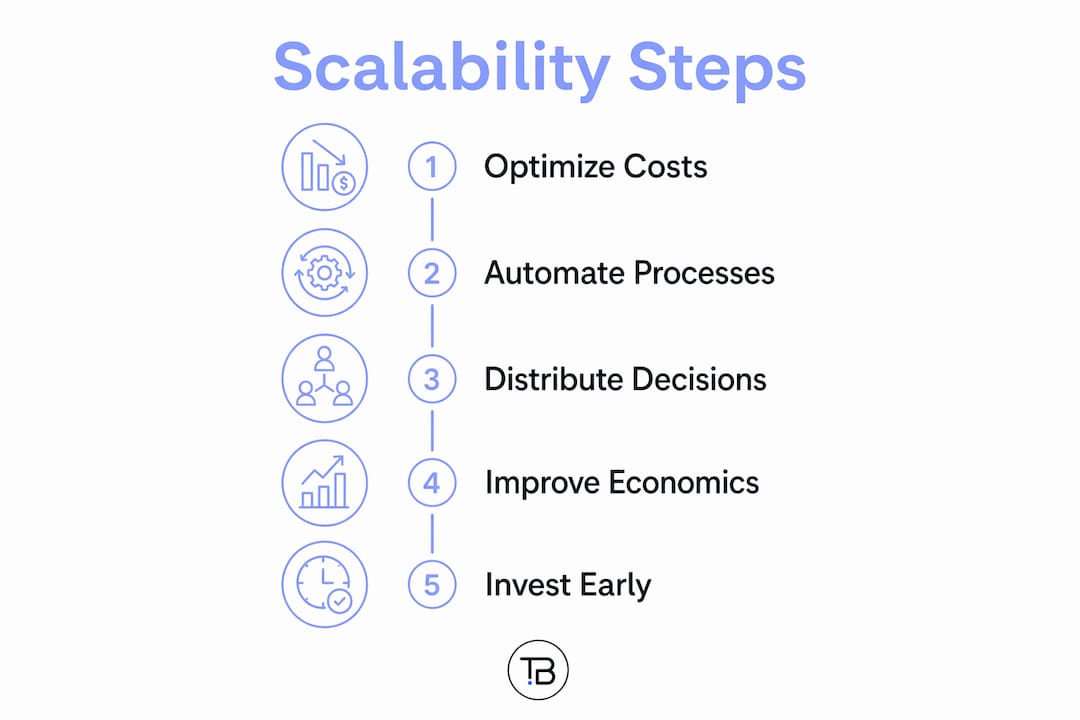
A business is scalable when revenue grows faster than costs, unit economics improve with volume, and delivery runs through systems rather than individuals.
| Point | Details |
|---|---|
| Scalability vs. growth | Scalable growth improves unit economics; ordinary growth adds costs at the same rate as revenue. |
| Measure before you spend | Track LTV:CAC (target above 3:1) and CAC payback (target under 12 months) before increasing acquisition spend. |
| Systems before headcount | Document your top three SOPs before hiring; automating a broken process compounds the problem. |
| Time your scale correctly | Three consecutive months of revenue growth with stable costs is a reliable trigger to begin scaling. |
| Tech Business Development | Tech Business Development helps founders implement workflow automation and reporting systems to build the operational foundation scaling requires. |
The part most scaling advice gets wrong
There is a version of scaling advice that reads like a motivational poster: move fast, think big, automate everything. It is not wrong exactly, but it skips the part that actually determines whether scaling works.
The real constraint is almost never market size or ambition. It is the gap between what a founder can hold in their head and what a system can reliably execute. Every business that has scaled past its founder’s personal bandwidth has done so by converting knowledge into process, and process into infrastructure. The ones that skipped that step and just hired faster ended up with a larger, more expensive version of the same chaos.
What I see consistently is that founders underestimate how much of their current “efficiency” is actually just their own pattern recognition filling in for missing systems. When you add people or channels before those systems exist, you do not get leverage. You get dilution.
The other thing worth saying plainly: the Harvard Six S framework and the MIT Sloan research on scaling patterns are not academic abstractions. They describe the same thing practitioners observe on the ground. Leadership alignment on customer, product, and process is not a soft prerequisite. It is the single variable that most reliably predicts whether a scaling effort holds together or falls apart six months in.
Scale the infrastructure first. The revenue follows.
How Tech Business Development helps you build systems that scale
Cutting operational costs while growing revenue is the core promise of scalability, and it is exactly what Tech Business Development is built to deliver. Where most founders hit a ceiling because manual processes cannot keep pace with demand, Tech Business Development’s workflow automation and AI-driven reporting systems remove that ceiling before it becomes a crisis. The result: less time spent on administrative tasks, cleaner data for decisions, and an operational foundation that holds up as volume grows.
The firm handles workflow automation design, Google Analytics 4 and Tag Manager setup, SEO, and full website builds, all at rates structured for small and growing businesses. Clients in marketing, logistics, and technology have used these systems to cut operational costs by up to 50% and shift founder time from firefighting to growth. If you are ready to build the infrastructure your next stage of growth requires, explore Tech Business Development’s services or review the pricing options to find the right starting point.
Useful sources and further reading
The following sources informed this guide and are worth bookmarking for deeper study:
- Scalability: True Meaning for Businesses — First Round Review. The clearest practitioner-level definition of scalability and why unit economics are the real test.
- Building Scalable Business Models — MIT Sloan Management Review. The five scaling patterns drawn from research across more than 90 businesses; essential reading for founders choosing a growth model.
- How to Scale a Business: 6 Tactics — Harvard Business School Online. Covers the organisational prerequisites, including the Six S framework, with practical guidance on leadership alignment.
- What Is Scalability? — Investopedia. A concise reference definition useful for communicating the concept to investors or board members.
- How to Scale Your Business Without Breaking It — Forbes. A grounded counterpoint to blitzscaling; particularly relevant for non-tech and Canadian businesses.
- What It Costs to Scale a Business — Inc. Honest accounting of the hidden costs of scaling without systems.
- Anatomy of Work — Asana. Research on how routine tasks consume operational capacity; the case for automation before scale.
- Tech Business Development blog — Practical implementation articles on automation, analytics, and workflow design for founders building scalable operations.
Recommended