How data drives real cost reduction in your business


Data reduces costs not by accident, but by design. When you apply analytics to your operations, you expose exactly where money is leaking: redundant processes, bloated inventories, underused infrastructure, and compliance gaps that quietly drain budgets. The role of data in cost reduction is direct. It replaces guesswork with evidence, and evidence with action. According to McKinsey, targeted improvements in data sourcing, architecture, and governance can cut annual data spend by 5–15% in the short term, with that figure nearly doubling when automation and process redesign follow.
The mechanisms are practical, not theoretical:
The sections below cover each of these levers in depth, from foundational techniques to AI-driven enterprise redesign.
How data cost reduction techniques work in practice
The most overlooked source of savings is the data infrastructure itself. Before you can use data to cut costs elsewhere in the business, you need to stop overspending on the data environment.
Pro Tip: Before investing in new analytics tools, run a data spend audit. Most businesses find a notable share of their data budget is funding infrastructure they no longer actively use.

Why data governance is a cost reduction tool, not just a compliance requirement
Governance is where cost discipline and data quality meet. Without it, data sprawls, duplicates, and becomes expensive to maintain and trust.
How automation lowers the cost of managing data
Automation removes the labour cost from repetitive data tasks. That is its most direct financial contribution, but not its only one.
What cloud computing actually does to your data costs
Cloud infrastructure changes the economics of data management in ways that go beyond simply moving servers off-site.
How analytics uncovers cost savings across business functions
Analytics does not just manage data costs. It finds cost reduction opportunities across the entire business.
Data assets also help firms manage supply chain fluctuations more effectively. Research shows that companies with strong data asset capabilities demonstrate better inventory turnover and reduced cost stickiness, particularly in regions with high levels of digital economy development.

Advanced AI-driven approaches that compound cost savings
The businesses achieving the largest cost reductions are not simply adding AI tools to existing workflows. They are redesigning workflows around AI from the ground up.
BCG research found that
three times greater cost reduction than laggards. At one major tech client, AI-enabled processes delivered large cost reductions in specific workflows, with significant annual operating expenditure savings against a multibillion-dollar cost base.
The distinction matters. Layering a copilot onto an existing process captures a fraction of the potential value. Redesigning the process around AI decisions, rather than AI-assisted tasks, is where costs compound downward.
Several strategic principles separate AI leaders from the rest:
Canadian businesses using data to cut costs
Canadian organisations across sectors have applied data-driven approaches to achieve measurable savings, often by addressing the same structural problems: fragmented data, manual processes, and underused infrastructure.
A building products manufacturer working with NTT DATA replaced manual freight data collection with an automated feed from the Snowflake Data Marketplace. The result was an estimated $3–$5 million in annual savings from freight lane optimisation alone, alongside 6,000 hours saved through cloud adoption. The company had previously struggled to extract meaningful insights from multiple data sources and custom hierarchies within its SAP environment. A modern analytics platform changed what was possible.
RSM Canada documented a comparable shift in the analytics infrastructure space. Migrating from legacy on-premises analytics to Microsoft Fabric delivered $15–16 million in annual savings for the client, with reporting speed improving by 40–50%. The legacy system had been consuming resources in maintenance, licensing, and analyst time. The cloud-native replacement eliminated most of that overhead.
These cases share a pattern: the savings came not from a single clever algorithm, but from fixing the data foundation first. Clean, accessible, well-governed data is what makes every downstream analytics investment pay off. For businesses evaluating where to start, signs your business needs automation often show up in exactly the same places these companies found their biggest savings.
How to measure the ROI of data-driven cost reduction
Measuring return on investment for data initiatives is harder than measuring it for a piece of equipment, but it is not optional. Without measurement, savings get reabsorbed and programmes lose executive support.
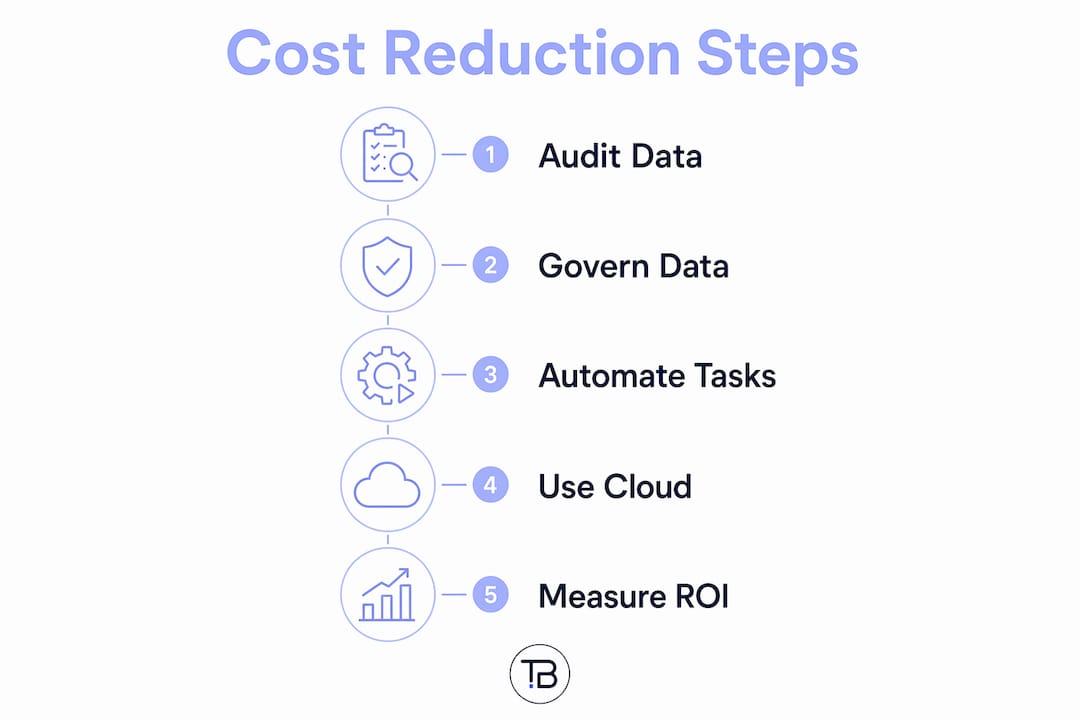
Start with a baseline. Before any initiative launches, document current spending in the target area: data storage costs, analyst hours spent on manual reporting, procurement spend by category, or inventory holding costs. The baseline is what you measure against.
Separate cost avoidance from cost reduction. Cost avoidance (preventing a cost from occurring) and cost reduction (eliminating an existing cost) both have value, but they need to be tracked separately. Mixing them inflates apparent ROI and creates credibility problems when finance teams review the numbers.
Use a structured framework. Forrester’s Total Economic Impact methodology, applied to cloud analytics deployments, found that a composite organisation achieved a three-year net present value of $4.3 million and an ROI of 209% from analytics investment, including $2.5 million in data preparation time savings and $2.1 million in legacy system retirement. The methodology works because it forces attribution: each benefit is tied to a specific change, not to general “digital transformation.”
Track leading indicators alongside financial outcomes. Data quality scores, pipeline reliability rates, and analyst time-on-value (time spent on analysis versus data wrangling) predict future cost performance before it shows up in the P&L. If data quality is improving, cost reduction will follow.
Set hard targets and review them quarterly. Efficiency gains that are not tied to budget lines disappear. Assign each initiative a dollar target, a timeline, and an owner. Review progress against those targets at the same cadence as other financial reporting.
Risks of relying on data for cost reduction and how to manage them
Data-driven cost reduction carries real risks. Recognising them early is what separates programmes that deliver from those that stall or backfire.
Data quality failures undermine every downstream decision. If the data feeding your cost models is inaccurate, the models will confidently recommend the wrong actions. Invest in data quality monitoring before scaling any analytics initiative. Automated data validation at ingestion catches errors before they propagate.
Over-reliance on historical data misses structural shifts. Models trained on past patterns can fail when market conditions change abruptly. The supply chain disruptions of recent years exposed this vulnerability in inventory and demand forecasting models that had performed well for years. Build in regular model revalidation cycles, not just at launch.
Compliance costs can offset savings. As noted earlier, privacy regulations like GDPR increase the variable cost of data by around 20%. A cost reduction programme that generates savings in one area while triggering compliance penalties in another is not a net win. Governance and legal review should be part of the programme design, not an afterthought.
Fragmented initiatives fail to move the P&L. BCG’s research identified this as one of the most common failure modes: too many scattered pilots, none of them reaching the scale needed to affect the cost base. Concentrate investment in core workflows where the financial impact is largest, and resist the temptation to run experiments everywhere simultaneously.
Automation can create new dependencies. Automated pipelines that break silently are more dangerous than manual processes that fail visibly. Build monitoring and alerting into every automated workflow, and maintain clear escalation paths for when systems fail. The office automation practices that hold up over time are the ones designed with failure modes in mind from the start.
Key takeaways
Data-driven cost reduction delivers the largest and most durable savings when governance, automation, and AI-led process redesign work together rather than in isolation.
PointDetailsFix data infrastructure firstConsolidating repositories and eliminating unused feeds can cut annual data spend by 5–15% before touching other functions.Governance reduces hidden costsClear data ownership and access controls prevent sprawl, duplication, and the compliance exposure that adds up to 20% to data costs.AI redesign outperforms AI add-onsAI leaders achieve 3x greater cost reduction than laggards by redesigning workflows around AI, not layering tools onto existing processes.Measure against a hard baselineTie every initiative to a specific dollar target and review it quarterly; savings not tracked against a baseline get reabsorbed.Canadian cases show real numbersCloud analytics migrations and freight optimisation programmes have delivered $3–16 million in annual savings for Canadian and North American businesses.
Ready to put data to work on your cost base? Tech Business Development builds automation and analytics systems tailored to Canadian businesses, from workflow redesign to real-time reporting. If your operations are generating data but not generating savings, that gap is exactly where we work.
Recommended