Role of automation in operations: a 2026 guide


Automation in business operations is defined as the use of technology to execute repeatable tasks and multi-step workflows without continuous human input. The role of automation in operations has shifted from simple task replacement to full workflow redesign, where AI agents, orchestration platforms, and governed processes work together to reduce errors, cut costs, and free teams for higher-value work. Studies show automation and AI adoption reduce task completion time by 15% to over 50%, particularly in customer support, software development, and accounting. That range reflects a critical truth: results depend far more on how you deploy automation than on which tools you choose.
How does automation improve operational efficiency?
Automation improves operational efficiency by removing the manual handoffs that slow workflows and introduce errors. When a task moves from one person to another, context gets lost, deadlines slip, and quality varies. Automated workflows eliminate those gaps by routing tasks, triggering approvals, and logging every action without human intervention.

The impact goes beyond speed. Automation’s value shows up in faster cycle times, smaller backlogs, and stronger SLA compliance, not just in reduced manual hours. A procurement team that automates purchase order approvals, for example, cuts processing time from days to minutes and gains a full audit trail at no extra cost.
Centralised platforms outperform fragmented, do-it-yourself tool stacks. Organisations that move from scattered automation scripts to a unified platform can expect a 749% ROI over five years, driven by revenue protection and risk reduction rather than administrative savings alone. That figure signals something most managers miss: the biggest gains come from protecting operations against failure, not just from doing tasks faster.
Key efficiency gains from process automation include:
Pro Tip: Before automating any workflow, map it end to end and remove unnecessary steps. Automating a broken process accelerates the inefficiency rather than fixing it.
What organisational changes are needed to implement automation?
Automation does not succeed by installing software. Productivity gains from automation depend heavily on complementary investments in workflow redesign, workforce skills, and organisational governance. Without those three elements, outcomes range from modest to negative.
The first change is process redesign. The most successful leaders strip unnecessary steps before deploying any technology. A finance team that automates a five-step invoice approval process without first questioning whether all five steps are necessary will simply move waste faster. Redesign the process, then automate what remains.
The second change is governance. Automation at scale requires a control plane: a set of rules that define who can trigger what, what requires human review, and how every action is logged. Neglecting governance is the leading cause of automation failures as systems grow. Build permission controls and audit logs from day one, not as an afterthought.
The third change is skills investment. Managers and frontline workers need to understand what the automated system does and when to override it. Training is not optional. Teams that understand their automated workflows catch edge cases early and prevent small errors from becoming large incidents.
A practical sequence for organisational readiness:
Pro Tip: Assign a workflow owner for every automated process. Ownerless automation drifts over time as business rules change, creating silent failures that are hard to diagnose.
How do AI-powered automation and orchestration layers work together?
AI-powered operations embed AI agents directly into workflows, shifting the focus from automating individual tasks to redesigning entire operating models. An AI agent handles the interpretation-heavy steps: reading an unstructured email, classifying a customer complaint, or extracting data from a non-standard invoice. The orchestration layer then routes the output to the next step, whether that is a human reviewer, an RPA bot, or an API call to another system.
Orchestration platforms unify AI, robotic process automation (RPA), APIs, and human oversight into governed, multi-step workflows. This integration is what makes AI-powered operations reliable at scale. Without orchestration, AI agents operate in isolation and cannot hand off work, enforce policies, or maintain a record of what happened and why.
The practical difference between basic automation and AI-powered orchestration shows up clearly across three common business functions:
FunctionBasic automationAI-powered orchestrationFinanceRoutes invoices by vendor codeReads unstructured invoices, flags anomalies, routes for approvalProcurementSends purchase order confirmationsMatches orders to contracts, escalates exceptions, logs decisionsCustomer serviceSends auto-reply emailsClassifies intent, resolves tier-one issues, escalates with full context
A key advantage of agentic automation is operational memory. AI agents retain context across steps in a workflow, so a customer service agent that hands off a complex case to a human reviewer passes along the full interaction history. That continuity reduces resolution time and improves customer satisfaction without requiring the human to start from scratch.
Pro Tip: Start with one high-volume, well-defined workflow when piloting AI-powered orchestration. A contained pilot gives you clean data on performance and surfaces governance gaps before you scale.
What measurable outcomes result from automation in operations?
The business case for automating operations is grounded in measurable outcomes across four areas: cost, quality, speed, and workforce productivity. Each area compounds the others when automation is deployed with proper governance.
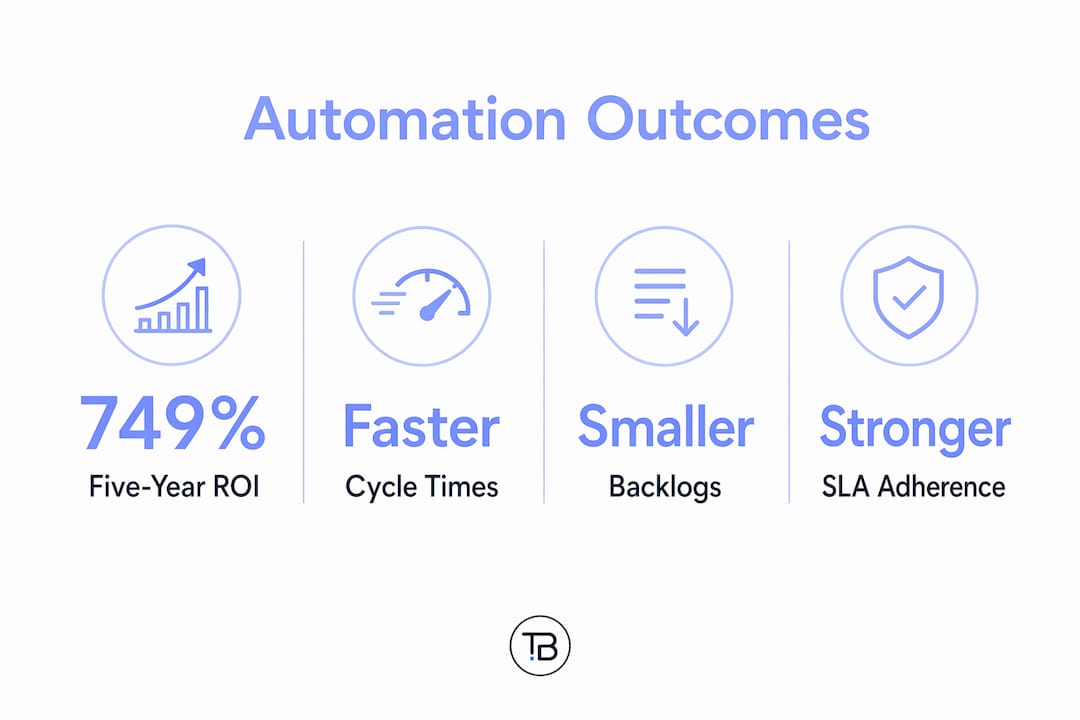
On cost, organisations that consolidate fragmented tools into a supported automation platform report a 749% five-year ROI. Tech Business Development clients in logistics and marketing have reduced operational costs by up to 50% through tailored workflow automation, a figure that reflects both direct labour savings and reduced incident costs.
On quality and speed, enterprises with AI-embedded workflows achieve faster cycle times, smaller backlogs, and stronger SLA compliance. Incident response times drop when automated monitoring triggers alerts and routes tickets without waiting for a human to notice the problem.
On workforce productivity, the effect is more nuanced than most managers expect. Automation compresses skill disparities by disproportionately boosting lower-performing workers rather than only benefiting top performers. That means the entire team’s baseline productivity rises, not just the output of your best people. For managers, this is a significant finding: automation is a workforce development tool as much as an efficiency tool.
You can also check signs your business needs automation to assess whether your current operations are ready to capture these gains.
What practical steps help managers start or scale automation?
Starting automation without a clear framework produces inconsistent results. The following steps give managers a repeatable path from pilot to scale.
Identify the right starting point. Choose workflows where context loss causes the most failures. Handoffs between departments, manual data re-entry between systems, and approval chains with no audit trail are all strong candidates. These are the processes where automation delivers the fastest, most visible return.
Build your control plane early. A governance control plane includes human-in-the-loop overrides, observability dashboards, and strict permission settings. Building this infrastructure before scaling prevents the catastrophic failures that occur when automated systems encounter edge cases with no human fallback.
Equip your team. Automation changes how managers and frontline workers spend their time. Provide training on monitoring dashboards, exception handling, and escalation procedures. Teams that understand their automated workflows catch problems early and adapt faster when business rules change.
Measure beyond speed. Track error rates, compliance scores, SLA adherence, and employee time freed alongside task completion time. Speed alone is a misleading metric. A workflow that runs faster but produces more errors has not improved. For a deeper look at cost outcomes, the guide on reducing IT operational costs covers how workflow changes translate directly to budget savings.
Scale what works. Once a pilot workflow delivers consistent, measurable results, replicate the governance model and training approach across similar processes. Do not scale until the pilot is stable. Premature scaling amplifies both the benefits and the failures of your current setup.
Pro Tip: Measure your automation programme’s health monthly, not just at launch. Business rules change, volumes shift, and workflows that performed well at launch can degrade silently without regular review.
Key takeaways
Automation delivers its greatest operational value when workflow redesign, governance, and workforce training accompany the technology deployment.
PointDetailsRedesign before automatingStrip unnecessary steps from workflows before deploying any technology to avoid accelerating inefficiency.Governance is non-negotiableBuild human overrides, permission controls, and audit logs from day one to prevent scaling failures.ROI goes beyond labour savingsCentralised automation platforms report 749% ROI over five years, driven by risk reduction and revenue protection.Automation lifts the whole teamSkill compression effects mean lower-performing workers gain the most, raising the entire team’s productivity baseline.Measure quality, not just speedTrack error rates, SLA compliance, and cycle times alongside task completion speed for an accurate picture of impact.
What most automation guides get wrong
Most articles about automation frame it as a technology decision. In my experience working with business owners across marketing, logistics, and technology, the technology is almost never the hard part. The hard part is convincing a team to change how it works.
I have seen well-funded automation projects fail because the process being automated was never questioned. The team automated a seven-step approval chain that should have been two steps. The result was a faster, more reliable version of a bad process. The lesson stuck with me: technology amplifies whatever you give it, good or bad.
The other pattern I keep seeing is governance treated as a phase-two problem. Leaders want to move fast, so they skip the control plane and promise to add oversight later. Later rarely comes. When an automated system hits an edge case with no human fallback and no audit trail, the failure is always worse than expected.
The businesses that get the most from automation treat it as an operating model question, not a software question. They ask: how should this work, who is responsible, and what happens when it breaks? Those three questions, answered before deployment, separate the 749% ROI stories from the cautionary tales.
How Tech Business Development helps you automate operations
Automation works best when it is built around your specific workflows, not adapted from a generic template. Tech Business Development designs and implements tailored workflow automation solutions for businesses in marketing, logistics, and technology, with a focus on cutting manual tasks and reducing operational costs by up to 50%.
Every engagement includes governance setup, team training, and real-time data visibility so your managers can monitor performance from day one. Whether you are running your first automation pilot or scaling an existing programme, Tech Business Development handles the technical setup, integration, and ongoing support so your team can focus on growth. Visit Tech Business Development to see how the right automation strategy translates directly into measurable operational results.
FAQ
What is the role of automation in operations?
Automation in operations is the use of technology to execute repeatable tasks and multi-step workflows without continuous human input. Its primary role is to reduce errors, cut cycle times, and free teams for higher-value work.
How does automation improve business efficiency?
Automation removes manual handoffs that cause delays and errors, enabling faster approvals, consistent compliance, and real-time audit trails. Organisations with centralised automation platforms report up to 749% ROI over five years.
What organisational changes does automation require?
Successful automation requires workflow redesign, governance controls, and workforce training before and after deployment. Without these, productivity outcomes vary widely and failures become harder to diagnose.
How do AI agents differ from basic automation?
Basic automation follows fixed rules for structured tasks. AI agents handle interpretation-heavy steps like reading unstructured documents or classifying intent, and pass results to an orchestration layer that manages approvals and routing.
How do I know if my business is ready for automation?
Businesses ready for automation typically have high-volume, repeatable workflows with frequent manual handoffs, data re-entry between systems, or approval chains that lack audit trails. Reviewing automation readiness signals is a practical first step.
Recommended