Reduce IT operational costs with workflow optimisation


Workflow-based IT cost reduction is the practice of eliminating redundant processes, automating repetitive tasks, and rightsizing infrastructure to cut expenses without degrading service quality. Small to mid-sized businesses that apply this approach to reduce IT operational costs through workflow improvements typically achieve 15% to 40% cost reduction across licensing, cloud compute, and support operations. The industry term for this discipline is IT cost optimisation, which differs from blunt cost cutting by aligning every dollar saved with measurable business outcomes. FinOps principles and tiered support models are two of the most widely adopted frameworks for making this work at scale.
How to reduce IT operational costs through workflow mapping
The single most common reason IT cost initiatives fail is that teams skip the diagnostic phase. Before you automate anything or cancel a single licence, you need a clear picture of what your workflows actually look like today.
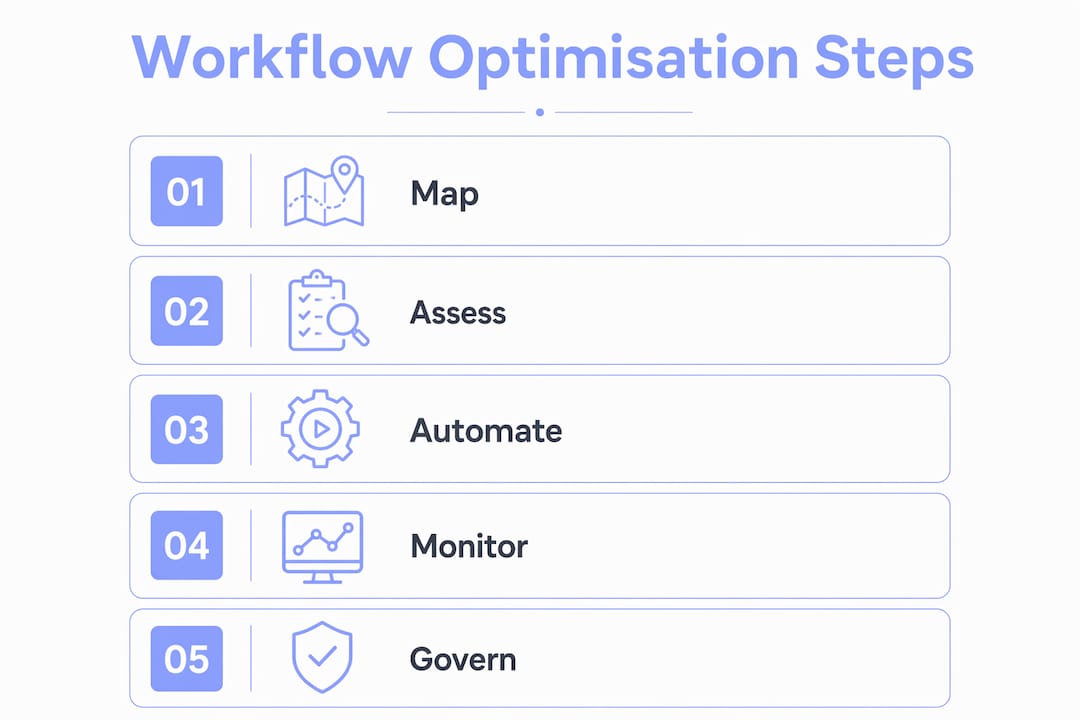
A manual process mapping exercise is the right starting point. Walk through each IT workflow step by step, documenting who does what, how long it takes, and whether the step produces a measurable output. Manual process mapping consistently reveals 30–40% redundant steps, including duplicate data entry and manual approvals that no one has questioned in years. Eliminating those steps before automation means you are building on a clean foundation, not encoding waste into software.

A data quality audit runs in parallel with process mapping. MIT Sloan research identifies poor data quality as the primary cause of AI automation failures, ahead of tool limitations and staff resistance. Automating a workflow with dirty data does not reduce effort. It scales errors.
The practical steps to complete before any automation project:
Pro Tip: Use time-tracking data from your IT service management platform for two weeks before mapping sessions. Real usage data exposes bottlenecks that team interviews miss.
What are the fastest ways to cut IT expenses in 30 days?
Quick wins exist in every IT environment. The goal in the first 30 days is to recover cash with minimal disruption, then use that momentum to fund deeper optimisation work.
Prioritising these five actions delivers the 20–35% IT spend recovery that most SMBs leave on the table. That recovery requires no new software and no headcount changes.
Licence audits alone recover 10–30% of software spend. That figure represents real cash, not projected savings from future automation.
How to implement automation without sacrificing quality
Automation is a data quality project before it is a technology project. Teams that deploy automation tools on top of unaudited workflows routinely find that ticket volumes increase rather than decrease, because errors now propagate faster.
The phased approach that produces the fastest return on investment starts with high-impact, low-effort workflows. Automation phased by impact and effort delivers the quickest savings: recurring reports, status summaries, and password reset tickets are ideal first targets. Complex workflows that touch multiple systems or require judgement calls belong in a later phase, after data cleanup is complete.
Tiered support models are the structural backbone of IT cost optimisation. Tier 1 and Tier 2 support tickets represent the highest volume and the lowest complexity in most SMB environments. Automating resolution paths for these tiers carries a 60–75% automation potential in Level 1 and Level 2 support. That translates directly into lower cost per ticket and faster resolution times.
Key principles for automation implementation:
Pro Tip: Before automating a Tier 1 support workflow, run it manually for two weeks with a standardised script. If the manual version reduces resolution time, the automated version will too. If it does not, the problem is the process, not the tooling.
Continuous monitoring prevents cost creep after automation goes live. Without it, teams add exceptions and workarounds that gradually rebuild the complexity you eliminated.
What governance practices sustain IT cost savings long-term?
One-time cost reductions rarely hold. Without structural governance, licence counts creep back up, idle cloud resources reappear, and the savings from your first audit evaporate within two quarters.
The most durable governance structure is a repeatable 90-day cycle. Structural governance over ad hoc reductions builds recurring savings through scheduled visibility and review rather than reactive cuts. Each 90-day cycle covers four activities:
Showback reporting is the most underused governance tool in SMB IT. Embedding cost accountability via showback reporting in engineering and operations workflows turns cost into a design conversation. When teams see the dollar cost of the infrastructure they consume, spending behaviour changes without mandates.
Governance activityFrequencyPrimary benefitLicence rightsizingEvery 90 daysRecovers 10–30% of software spendCloud cost auditEvery 90 daysPrevents idle resource accumulationContract reviewRolling, 90-day horizonEnables proactive renegotiationWorkflow KPI reviewMonthlyCatches cost creep early
Protecting innovation budgets is as important as cutting waste. Cost optimisation focuses on measurable business outcomes and preserves the investments that drive future revenue. Cancelling projects and cutting headcount indiscriminately destroys long-term value. The goal is to redirect waste into growth, not to shrink the IT function.
Key takeaways
Reducing IT operational costs through workflow optimisation requires waste elimination first, automation second, and structural governance to hold the gains permanently.
PointDetailsMap before you automateManual process mapping reveals 30–40% redundant steps that must be removed before automation begins.Quick wins fund deeper workSaaS licence audits and idle cloud terminations recover 20–35% of IT spend within 30 days.Data quality gates automationAutomating workflows with poor data scales errors; audit data completeness before deploying any automation tool.Phase automation by impactStart with high-impact, low-effort workflows like recurring reports and Tier 1 support tickets for fastest ROI.Governance sustains savingsA repeatable 90-day cycle of licence reviews, cloud audits, and showback reporting prevents cost creep.
Why most IT cost initiatives stall after the first quarter
Working with IT managers across small and mid-sized businesses, I have seen the same pattern repeat. The first audit goes well. Licences get reclaimed. A few idle cloud instances get terminated. The CFO is pleased. Then, three months later, the savings have quietly eroded and no one is sure why.
The root cause is almost always the same: the team treated the audit as a project rather than a practice. Cost optimisation is not a one-time event. It is a discipline that requires the same recurring attention as patch management or capacity planning.
The other mistake I see regularly is jumping to automation before the process is clean. I have watched teams spend months deploying workflow automation tools, only to discover that the automated process is just as broken as the manual one, only faster. The systematic approach to workflow improvement that actually works starts with a whiteboard and a process map, not a software demo.
Organisational buy-in matters more than most IT managers expect. When cost accountability stays inside the IT team, savings are fragile. When engineering and operations teams see showback reports and understand the cost of their infrastructure choices, the culture shifts. That cultural shift is what makes savings permanent.
The businesses I have seen achieve sustained reductions of 30% or more share one trait: they treated workflow optimisation as a continuous operating model, not a cost-cutting campaign.
How Tech Business Development helps SMBs cut IT costs through workflow improvement
IT managers who have completed their first process map often reach the same conclusion: the work is straightforward in principle and genuinely difficult in execution. Knowing which workflows to automate first, which licences to renegotiate, and how to build a governance cycle that actually sticks requires experience across dozens of environments.

Techbusinessdevelopment specialises in IT workflow assessment, automation implementation, and cost governance for small to mid-sized businesses. The team builds tailored solutions that target up to 50% reductions in operational costs by removing manual tasks and rightsizing infrastructure. Whether you need a full workflow audit or a focused automation project, the IT and automation services at Techbusinessdevelopment are priced for SMB budgets and scoped for fast results. Visit Techbusinessdevelopment to see how the team approaches IT cost optimisation for businesses at every stage.
FAQ
What does IT workflow optimisation actually mean?
IT workflow optimisation is the process of identifying and removing redundant steps, automating repetitive tasks, and rightsizing resources across IT operations to reduce cost and improve service quality.
How much can an SMB realistically save by improving IT workflows?
SMBs that apply systematic workflow optimisation typically achieve 15–40% IT cost reduction through licence audits, cloud rightsizing, and support automation combined.
Why does automation sometimes increase IT costs instead of reducing them?
Automation scales the behaviour of the underlying workflow. When that workflow contains errors or poor data, automation produces more errors faster, which increases resolution costs rather than reducing them.
What is showback reporting and why does it matter for IT cost governance?
Showback reporting makes infrastructure costs visible to the teams that generate them. Embedding showback reporting in engineering workflows turns cost into a shared design consideration, which produces more durable savings than top-down mandates.
How quickly can an SMB see results from a workflow optimisation initiative?
Quick wins from licence audits and idle cloud terminations are achievable within 30 days. Deeper savings from automation and governance cycles typically materialise within 60–90 days of implementation.