Automate Glue Work: Six Metric 2026 Marketing Ops for SMBs


Marketing operations for SMB is the system that turns scattered campaigns into a repeatable, measurable engine. It combines people, process, and technology so small teams stop reinventing the wheel every launch. The payoff is concrete: fewer hours lost to manual busywork, cleaner data, and campaigns you can actually improve over time. Start with a two-hour audit of your current workflow before you touch any new tool.
TL;DR:
- Small businesses should focus on automating their top manual tasks first, such as lead entry, reporting, and follow-up, to maximize time savings.
- Establishing clear workflows, a single source of truth, and defined ownership are crucial steps before implementing new tools or campaigns.
- A lean tech stack with native CRM integrations and one automation platform typically provides better value and ease of maintenance than complex enterprise solutions.
- Regular weekly and monthly reviews of key operational metrics help prevent system drift and ensure continuous improvement.
- Outsourcing technical setup and automation configuration can save time and reduce project stalls, especially when focusing on fixing the most burdensome manual bottlenecks.
Table of Contents
- What is marketing ops for SMB, exactly?
- Why do small businesses need marketing operations?
- How do you build marketing operations step by step?
- What KPIs should you track on a marketing ops scorecard?
- Running marketing ops solo or with a skeleton crew
- The marketing ops mistakes that quietly waste your budget
- What Tech Business Development sees working in practice
- Training your team (or yourself) for marketing ops work
- Connecting marketing ops with sales and customer service
- What successful SMB marketing ops actually looks like
- How much should marketing ops cost an SMB?
- Which tools actually fit an SMB marketing ops stack?
- What actually matters most in 2026 marketing ops
- Getting your marketing ops built without doing it all yourself
- Sources
What is marketing ops for SMB, exactly?
Marketing operations, often shortened to MOps, is not a department most small businesses have heard of until they’re drowning in spreadsheets and half-finished automations. It’s the discipline of designing how marketing work gets done, not doing the marketing work itself. Think of it as the difference between writing a blog post and building the system that schedules, tags, tracks, and reports on every blog post you’ll ever publish.
The standard way to describe it uses three pillars: people, process, and technology, sometimes called the PPT framework. People covers who owns what, even if that’s one person wearing five hats. Process covers the repeatable steps: how a lead moves from ad click to CRM entry to sales handoff. Technology covers the stack that automates those steps instead of relying on someone’s memory.
Here’s the distinction that trips up most small business owners: task management is doing the work. Operations is designing the system so the work gets done the same way every time, by anyone on the team, without you personally checking each step. A checklist for “post to social media” is a task. A documented workflow that automatically pulls content from a calendar, formats it for each platform, and logs performance into a dashboard is operations.
In a lean team, roles blur. The owner might set strategy and goals. A part-time marketer or freelancer might execute campaigns. A fractional operations partner, or a tool like an automated workflow platform, might handle the connective tissue between tools. The mistake is assuming operations needs a dedicated hire before it needs a dedicated process.
Why do small businesses need marketing operations?
Because most of the time your team spends isn’t marketing. It’s glue work: manually copying leads between systems, chasing down which spreadsheet has the latest numbers, reformatting the same report every Monday. That kind of repetitive administrative drag can consume as much as 70% of a small team’s time, according to Salesforce Ben’s research on marketing operations adoption. That’s not a rounding error. That’s most of a work week spent on tasks a workflow could handle automatically.
The pressure compounds at the leadership level too. 86% of marketers report their roles have expanded to include technical responsibilities like data analysis and reporting, according to Salesforce’s State of Marketing research. If you’re the owner or the sole marketing hire, that technical load lands on you by default, whether or not it’s what you’re good at.
Formalizing even a lightweight operations layer fixes three things at once: it reduces burnout by removing repetitive tasks from human hands, it speeds up delivery because campaigns follow a known sequence, and it improves ROI because you can finally see what’s working instead of guessing.
You’re likely ready to formalize marketing ops if you notice any of these signals:
- Campaigns regularly launch late because someone forgot a step.
- Nobody can answer “how many leads came from last month’s campaign” without a half-day of digging.
- The same manual task (data entry, report building, follow-up emails) happens weekly with no automation behind it.
- You’ve hired or fired a marketing person and had to rebuild all the “how we do things” knowledge from scratch.
How do you build marketing operations step by step?
This sequence works whether you’re doing it solo or splitting it across two or three people. Skipping steps to “get to the fun part” (new tools, new campaigns) is the single most common reason MOps projects stall.
- Audit your glue work and your current tech. List every recurring task that eats more than 15 minutes a week. Note every tool currently in use, including the free trial nobody cancelled. You’ll likely find overlap: two tools doing the same job, or a paid tool nobody uses.
- Set SMART goals tied to the business, not the marketing team. “Increase email open rate” is vague. “Grow qualified leads from email by 20% in Q2 to support the sales target” is specific, measurable, and tied to revenue.
- Map the customer journey and the sales handoff. Draw the path from first touch to closed deal. Mark exactly where marketing’s job ends and sales picks up. Ambiguity here is where leads get lost.
- Document workflows as SOPs. Write down, step by step, how a campaign gets built, approved, and launched. This is what makes the process survive a staffing change.
- Set data standards and a single source of truth. Decide which system is the “true” record for leads, revenue attribution, and campaign performance. Everything else feeds into it, not the other way around.
- Choose a lean martech stack. Resist enterprise platforms built for teams of 50. A hybrid model that keeps strategy in-house while outsourcing technical setup tends to deliver the best balance of cost and capability for SMBs.
- Assign ownership. Someone, even if it’s a fractional owner, needs to be accountable for each workflow and each dataset.
- Set a review cadence. A 30-minute weekly check-in on KPIs and a monthly deeper review keeps the system from drifting back into chaos.
Practical tool patterns that fit lean budgets: a CRM that integrates natively with your email platform (avoiding manual export/import), a shared dashboard tool rather than a custom-built one, and one automation platform handling the connections between them. Atlassian’s guidance on marketing operations points to the same starter list: documented workflows, a single source of truth, automated repetitive tasks, and a named process owner, achievable without a dedicated operations hire.
Pro Tip: Start automation with your top three most repetitive tasks, not your most exciting ones. The sequencing matters: audit first, automate the worst offenders, standardize your data, then scale campaign automation. Doing it backwards wastes setup time on automations that don’t stick.
What KPIs should you track on a marketing ops scorecard?
A scorecard only works if it’s short enough that you’ll actually look at it every week. Six metrics is plenty for most SMBs.
- Lead response time: how long between a lead entering your CRM and first contact.
- Campaign cycle time: how long from campaign brief to launch.
- Cost per qualified lead: total spend divided by leads that meet your sales-ready criteria.
- Marketing-to-sales handoff rate: percentage of marketing-qualified leads that sales actually accepts.
- Data completeness: percentage of CRM records with the fields sales and marketing actually need.
- Automation coverage: percentage of recurring tasks running without manual intervention.
| Readiness checklist item | Why it matters |
|---|---|
| Documented SOP for your top 3 campaign types | Removes single points of failure |
| Single source of truth for lead data | Stops reporting disputes between teams |
| At least one automated repetitive task | Confirms the system, not just intent, exists |
| Named owner for each core workflow | Prevents “nobody’s job” gaps |
| Monthly KPI review scheduled on a calendar | Turns the scorecard into a habit, not a document |
Review the scorecard weekly for the operational metrics (response time, cycle time) and monthly for the strategic ones (cost per lead, ROI). If a metric hasn’t moved in two review cycles, that’s your cue to revisit the workflow behind it, not just the number itself.
Running marketing ops solo or with a skeleton crew
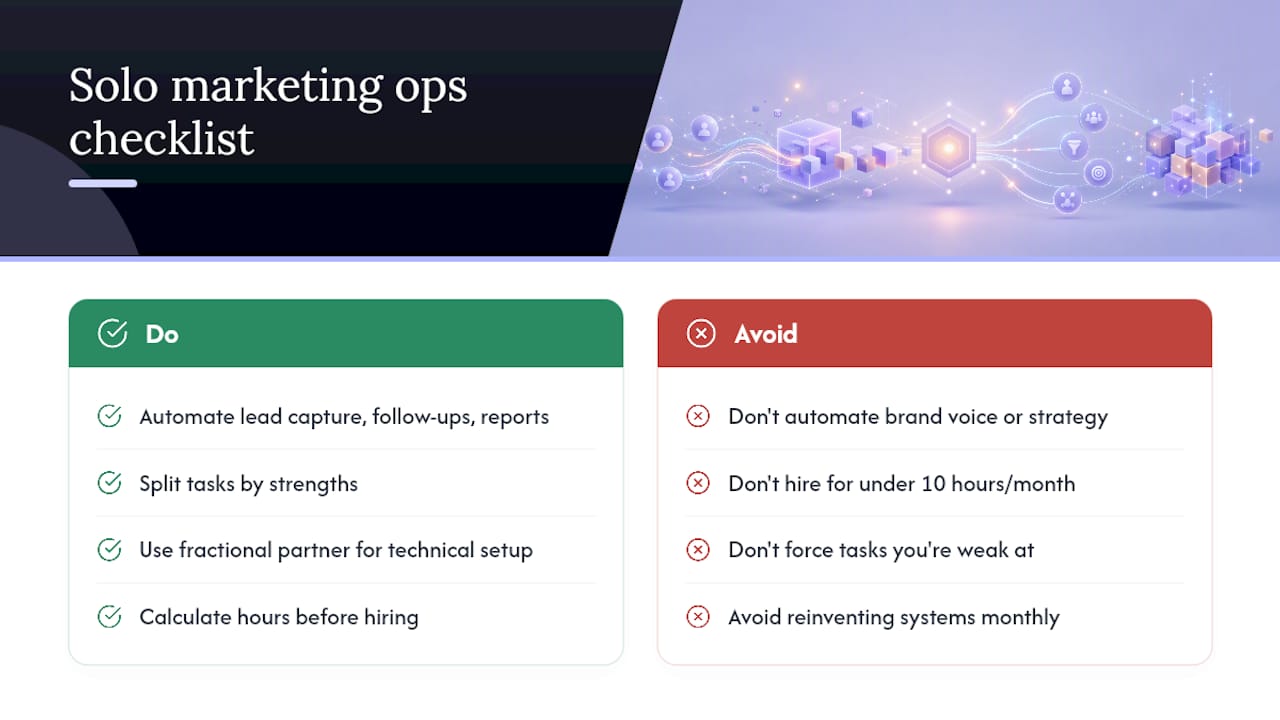
When you’re the entire marketing department, the goal isn’t building a full operations function. It’s triage: figure out which two or three automations return the most time, and let everything else wait.
Automate first: lead capture into your CRM, follow-up email sequences, and report generation. These are the tasks that are both high-frequency and low-judgment, which makes them the safest to hand to a workflow rather than a human. Leave anything requiring brand voice or strategic judgment, like campaign messaging or partnership outreach, in human hands longer.
Split responsibilities by strength rather than by title. If you’re better at strategy than spreadsheets, don’t force yourself into weekly report-building; automate it or delegate it to a fractional partner. AI-driven operations tools are increasingly capable of handling data cleanup and basic CRM entry, which frees a one-person team to focus on decisions rather than data entry.
A fractional partner or managed service usually beats hiring when the workload is real but not full-time, when the skill gap is technical (analytics setup, martech integration) rather than strategic, or when you need the system built once and maintained, not reinvented monthly.
Pro Tip: Before hiring anyone, calculate how many hours a month you’re spending on tasks a workflow could run unattended. If it’s under 10 hours, automation beats a new hire almost every time.
The marketing ops mistakes that quietly waste your budget
Three mistakes account for most failed MOps efforts in small businesses.
- Confusing task lists with systems. A to-do list isn’t a process; it dies the moment the person holding it leaves. The remedy is writing an actual SOP: numbered steps, who’s responsible, and where the output lives.
- Adopting enterprise tools too soon. A platform built for a 200-person marketing department comes with admin overhead your team doesn’t have time for. Choose lean, well-integrated tools first and only scale up when a specific limitation forces the issue.
- Leaving data ownership unclear. When nobody owns the CRM or the reporting dashboard, data quality rots fast. Name one process owner per dataset and set minimal rules (required fields, update frequency) rather than an elaborate governance policy nobody follows.
What Tech Business Development sees working in practice
Automation earns its keep fastest on the tasks nobody wants to do anyway: lead entry, report formatting, and campaign status updates.
A typical engagement runs a few weeks: audit current tools and workflows, configure the core Google services and CRM integrations, build a reporting dashboard, then hand off documentation so the client’s team can run day-to-day operations independently.
Automation won’t write your brand voice or close a sales call for you. It removes the repetitive work standing between your team and the strategic work that actually grows the business.
Training your team (or yourself) for marketing ops work
Marketing operations skills aren’t the same skills that make someone a strong copywriter or a creative campaign lead, and treating them as interchangeable is where a lot of SMBs stumble. The core competencies worth building are workflow documentation, basic data literacy (reading a dashboard, spotting a broken automation), and enough platform familiarity to troubleshoot a CRM integration without calling in outside help every time.
You don’t need a certification program to get there. Most CRM and automation platforms publish their own onboarding guides, and working through your actual tech stack’s documentation teaches more than a generic course. Pair that with a habit: every time you build a new workflow, document it as you go rather than after the fact. That single habit, done consistently, builds operations literacy faster than any training module.
For very small teams, cross-training beats specialization. Everyone touching marketing should understand how a lead flows from capture to close, even if they only own one piece of it. It means the system survives vacations, sick days, and turnover without collapsing. If budget allows a single training investment, spend it on your CRM’s advanced features. That’s usually where the most unused capability, and the most wasted subscription cost, sits.
Connecting marketing ops with sales and customer service
Marketing operations that stop at the marketing team’s edge solve half the problem. The real value shows up at the handoff points, where a lead becomes a sales conversation and a customer becomes a support ticket.
The practical fix is a documented handoff rule: a specific, agreed definition of what makes a lead “sales ready” (a form fill plus a pricing page visit, for example), and a maximum response time sales commits to once that threshold is hit. Without that agreement, marketing generates leads that sales calls “junk,” and sales closes deals marketing never gets credit for.
Customer service integration matters just as much, especially for SMBs where the same person often wears both hats. Feeding support ticket themes back into marketing (what questions keep coming up, what features confuse people) sharpens messaging and even future content. A CRM that unifies these functions rather than keeping sales, marketing, and support in separate tools removes the manual re-entry that causes half the friction between departments.
The goal isn’t a single mega-tool. It’s a shared source of truth that each team can see into, even if they work in different day-to-day interfaces.
What successful SMB marketing ops actually looks like
The pattern across small businesses that get marketing operations right isn’t having a big budget. It’s sequencing; they fix the worst manual bottleneck first, then build outward from there.
A common shape looks like this: a local service business realizes it’s manually re-entering leads from its website form into a spreadsheet, then into email software, then into a follow-up call list. Once that chain gets automated into a single CRM entry point, response time drops, follow-up rates rise, and the owner reclaims hours weekly that used to go to copy-pasting.
Another recognizable pattern involves reporting. A small marketing team spends a full day each month building a performance report by hand, pulling numbers from four different platforms. Once a shared dashboard replaces that ritual, the same information is available in real time. The bigger shift is what happens to that reclaimed day: it goes toward analyzing the data instead of assembling it.
Neither example requires enterprise software or a dedicated operations hire. Both require someone willing to document the current mess honestly, then fix the worst part of it first. That’s the through-line in nearly every SMB marketing ops success story worth telling: not sophistication, sequencing.
How much should marketing ops cost an SMB?
Marketing operations doesn’t need a line item that competes with your ad budget. The most cost-effective path is prioritization: fix the highest-friction manual task first, because that’s where the fastest payback lives, not the most impressive-looking tool.
Most lean automation and CRM tools for small businesses run in the range of a modest monthly subscription rather than a five-figure implementation. The real cost trap isn’t the software; it’s the setup time. A tool that takes weeks to configure correctly eats the exact hours you were trying to reclaim, which is why enterprise-grade platforms built for much larger teams routinely disappoint smaller ones on time-to-value.
Budget in three buckets: a small recurring spend for a core automation and CRM tool, a one-time setup cost (whether that’s your own time or a fractional partner’s), and a modest ongoing maintenance allowance for when integrations break or platforms update. Skipping that third bucket is the most common budgeting mistake; automations left unmaintained tend to quietly fail within a few months.
If cash is tight, sequence spending the same way you sequence implementation: automate the worst manual bottleneck first, prove the time savings, then reinvest part of that reclaimed time or budget into the next automation.
Which tools actually fit an SMB marketing ops stack?
The right stack for a small team looks nothing like the stack built for an enterprise marketing department, and that’s by design, not compromise.
Look for a CRM that integrates natively with your email and advertising platforms rather than requiring manual exports. Pair it with one automation tool that connects your CRM, email, and forms, instead of stitching together five single-purpose apps that each need separate logins and separate maintenance. A shared analytics dashboard beats a custom-built reporting spreadsheet almost every time, because dashboards update automatically and spreadsheets require someone to remember.
Fit and integration matter more than feature count. A tool with fewer features that your team actually uses daily beats a feature-rich platform that sits half-configured. For reference on structuring the rollout, this marketing automation checklist walks through a practical, step-by-step sequence for small teams choosing and implementing their first automation tools.
For lead generation specifically, purpose-built platforms like LeadPilot can standardize how leads get captured and scored before they ever reach your CRM, which reduces the manual sorting that otherwise falls on whoever’s watching the inbox. The pattern to avoid: buying tools for capabilities you might need someday instead of the workflow you’re stuck manually running today.
What actually matters most in 2026 marketing ops
The conventional advice on marketing operations still leans heavily on enterprise frameworks scaled down for small teams, and that’s the wrong starting point. Scaling down a system built for 50 people rarely produces something a team of two can actually run.
What the evidence in this article actually supports is narrower and more useful: fix the worst manual bottleneck first, automate the tasks that are frequent and low-judgment, and keep strategic work in human hands. Most small teams don’t have a strategy problem. They have a plumbing problem, and plumbing is exactly what automation is good at fixing.
Where most guides overcorrect is treating a hire as the solution. A fractional partner or a managed automation setup solves the same problem faster and cheaper for most SMBs, because the bottleneck is usually technical execution, not strategic thinking. Prioritize the audit before anything else. You cannot automate what you haven’t honestly mapped, and skipping that step is why so many automation projects stall six weeks in.
— Shayan Shirvani
Getting your marketing ops built without doing it all yourself
Reading a playbook is one thing. Configuring GA4 correctly, connecting your CRM to your ad accounts, and building a dashboard that actually reflects reality is another. Tech Business Development handles the technical setup that most SMB teams either delay for months or never get to at all, so you keep strategy in-house and hand off the plumbing.
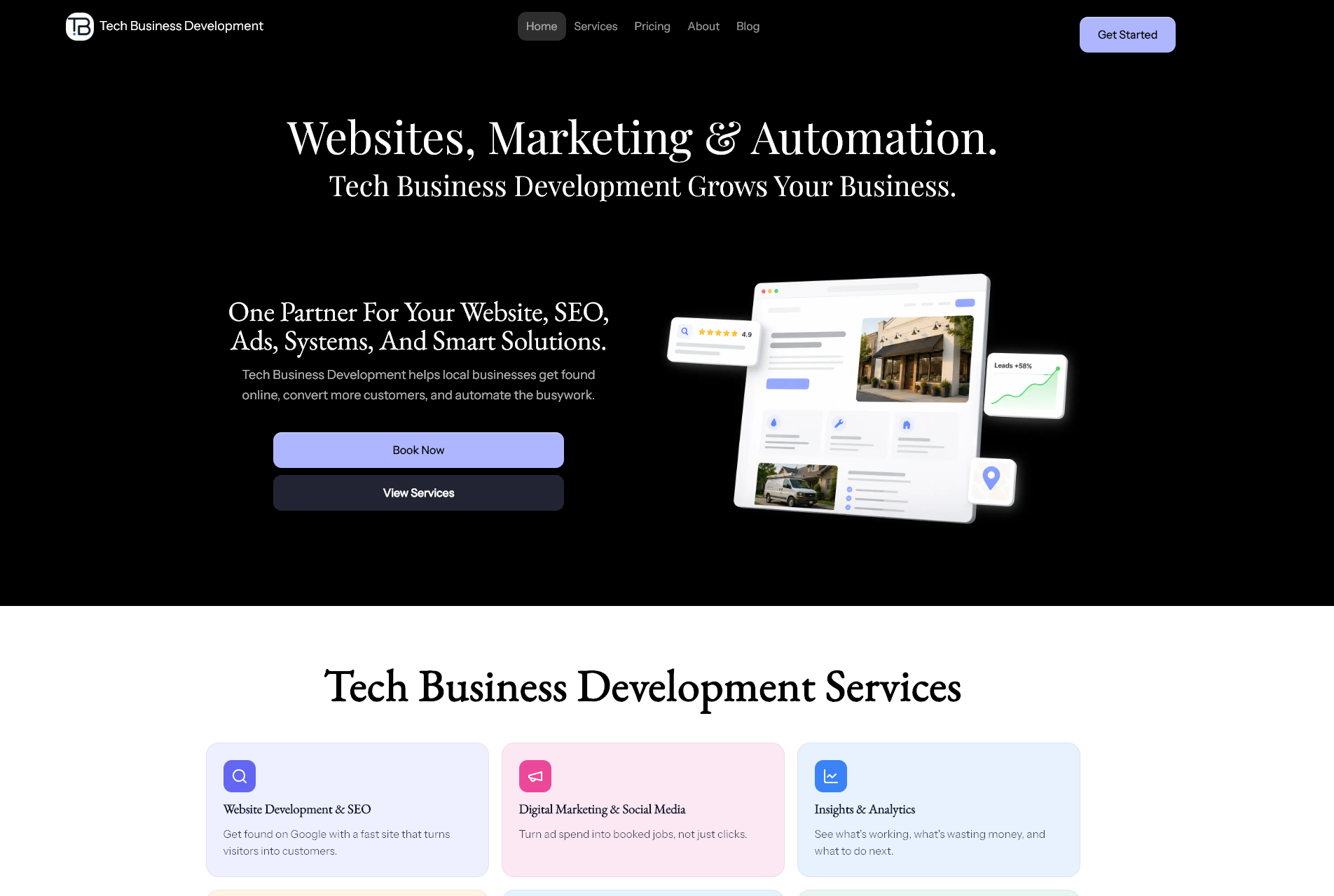
The relevant services include workflow automation setup, Google Business Profile, GA4, Google Tag Manager, and Google Ads configuration, CRM integration, and custom performance dashboards, all handled internally rather than farmed out to subcontractors. A typical engagement runs a few weeks from audit to a working, documented system your team can maintain going forward. That’s the hybrid model this article recommends in practice: strategy stays yours, the technical build gets handled fast and correctly the first time.
If your team is losing hours to manual reporting or a CRM that doesn’t talk to your ad accounts, start with a look at Tech Business Development’s services and get a sense of what a lean, working setup looks like for a business your size.
Sources
For deeper reading, Salesforce Ben’s marketing ops primer, HubSpot’s operations guide, and Shopify’s marketing overview each offer practical starting checklists worth referencing directly.
- Get started with marketing ops (Salesforce Ben)
- State of Marketing (Salesforce)
- Shopify: Marketing operations overview
Recommended