Google Ads management pricing: what it actually costs in 2026


Most businesses pay somewhere between $500 and $5,000 or more per month for Google Ads management, depending on ad spend, industry, and how the fee is structured.
Here’s the shape of it:
- Starter accounts (under $3,000/month ad spend): flat fees of $500 to $1,500
- Small business ($3,000 to $10,000/month ad spend): flat or hybrid, $1,000 to $3,000
- Growth/mid-market ($10,000 to $50,000/month ad spend): percentage or hybrid, 10 to 20% or $2,500 to $7,500 flat
Statistic to remember: management fees for most businesses land between $1,500 and $5,000 a month, separate from the ad spend itself.
Your next move isn’t picking the cheapest quote. It’s comparing total monthly investment (management fee plus ad spend) across proposals, and confirming in writing exactly what tracking gets set up before anything launches.
Key Takeaways
Google Ads management fees typically range from $500 to $5,000+ monthly, and the right pricing model depends more on your ad spend tier than on which agency you choose.
| Point | Details |
|---|---|
| Match model to spend | Flat fees suit under $10,000/month ad spend; hybrid or percentage models fit growth accounts above that. |
| Budget for setup separately | Expect $1,000 to $5,000 in onboarding fees on top of the ongoing monthly retainer. |
| Confirm inclusions in writing | Creative, landing pages, and advanced tracking are commonly billed as add-ons, not bundled in. |
| Prioritize tracking quality | Clean conversion tracking through GA4 and Enhanced Conversions matters more to ROI than the fee itself. |
| Consider Tech Business Development | Bundles Google Ads setup, tracking, and automation into predictable monthly packages built for small and local businesses. |
Table of Contents
- Google Ads agency pricing models and how they actually work
- How much does Google Ads management cost at each spend tier?
- What’s included in a Google Ads management fee, and what costs extra?
- How do you compare Google Ads management quotes properly?
- Why our approach matters: measurement-first pricing changes the math
- How much does location affect Google Ads management pricing?
- Do pricing structures differ by industry or business size?
- Why does campaign complexity change what you pay?
- What contract terms are typical for Google Ads management?
- When to hire an agency vs. a consultant or software tool
- Get a predictable Google Ads management package built around tracking
- Sources
Google Ads agency pricing models and how they actually work
Every agency quote you’ll see boils down to five basic structures, and the label on the invoice matters less than what it incentivizes.
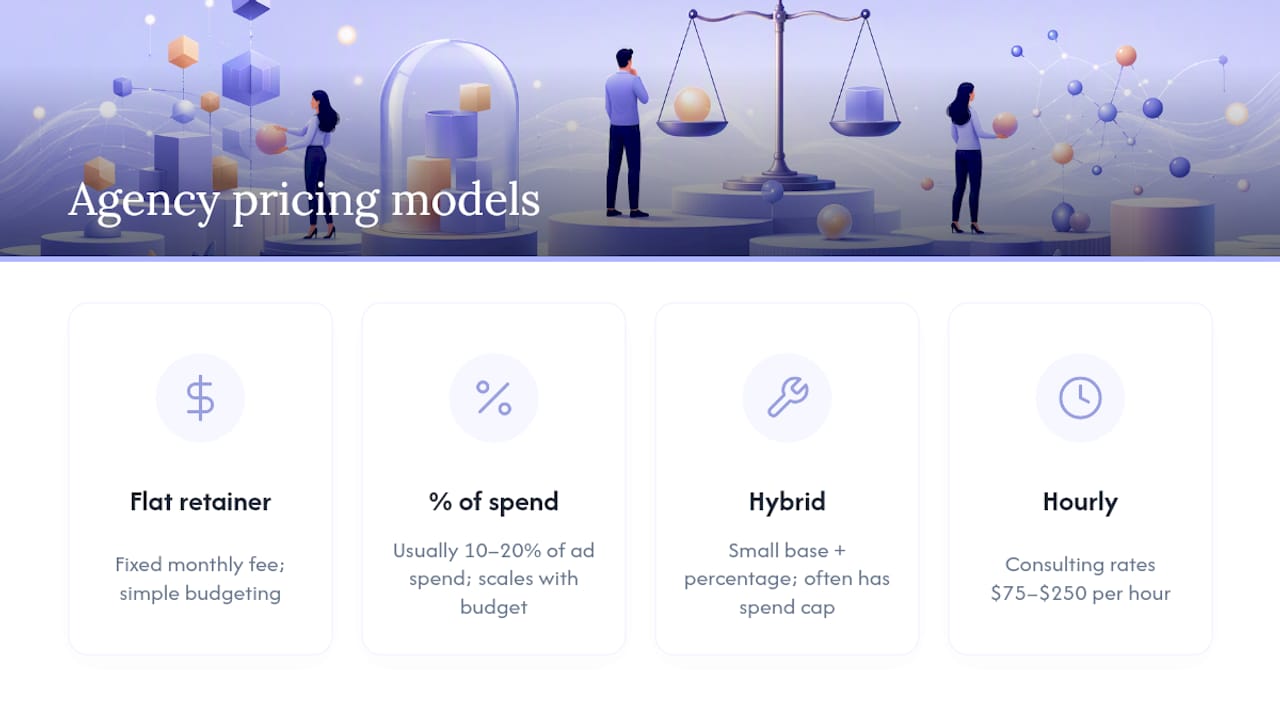
Flat monthly retainers charge a fixed fee regardless of spend fluctuations. You know your cost going in, which makes budgeting simple, but a flat fee can undercharge for a complex twelve-campaign account and overcharge for a simple five-keyword one.
Percentage of ad spend ties the fee to a slice of what you’re spending, usually 10 to 20%. It scales naturally as you grow, but it can also mean paying more without the agency doing meaningfully more work once an account matures and stabilizes.
Hybrid models combine a smaller base retainer with a percentage on top, often with a spend cap where the percentage stops climbing. This is increasingly the default for growth accounts because it protects the agency’s minimum viable fee while capping what the client pays at scale.
Hourly consulting suits businesses that need strategic input without ongoing management. Rates typically run $75 to $250 an hour depending on seniority.
Performance-based pricing ties some or all of the fee to results (leads, sales, cost per acquisition). It sounds appealing, but it requires airtight tracking to work, and it often costs more in the long run than a flat structure once an agency prices in its own risk.
Pro Tip: Ask what happens to the fee if you cut your ad spend in half. A percentage model should drop proportionally. A flat retainer that suddenly gets “renegotiated” the moment your budget shrinks is a sign the original number was never really tied to your account.
Freelancers and small shops tend to price at the low end of flat fees; full-service agencies with dedicated account teams sit at the high end, and that range runs from about $500 to $5,000+ per month.
How much does Google Ads management cost at each spend tier?
The honest answer depends entirely on how much you’re spending on ads, not just what the agency charges for labour. A $2,000 monthly ad budget and a $50,000 one require completely different levels of attention, and pricing should reflect that.
Here’s how the tiers typically break down, combining management fees with realistic ad spend to show total monthly investment:
| Ad spend tier | Monthly ad spend | Typical management fee | Total monthly investment |
|---|---|---|---|
| Starter | $1,000–$3,000 | $500–$1,000 flat | $1,500–$3,000 |
| Small business | $3,000–$10,000 | $1,000–$2,500 flat | $2,500–$7,500 |
| Growth | $10,000–$50,000 | 10–20% or $2,500–$7,500 hybrid | $2,500–$7,500 |
| Scale/mid-market | $10,000–$50,000 | 10–20% or $2,500–$7,500 | $2,500–$7,500 |
| Enterprise | $5,000+ | 10–20% or custom retainer | Custom quote |
Three worked examples make this concrete:
- A local service business spending $2,500/month on ads pays roughly $750/month flat, landing total investment near $3,250. At this level, a percentage model rarely makes sense because 15% of $2,500 barely covers an hour of a strategist’s time.
- A regional retailer spending $15,000/month often pays a hybrid fee of $1,500 base plus 10% of spend above $10,000, totalling around $2,000 in fees, or roughly $17,000 all in.
- A multi-location franchise spending $60,000/month typically negotiates 10% of spend, landing at $6,000 in management fees for a total investment near $66,000.
Most guides converge on $3,000 to $5,000 a month in ad spend as the point where managed services start returning more value than they cost. Below that, a carefully implemented SaaS management tool or a senior freelance consultant often outperforms a full agency retainer on pure ROI, simply because the fee doesn’t eat a disproportionate share of the budget.
What’s included in a Google Ads management fee, and what costs extra?
A standard retainer should cover ongoing optimization: bid adjustments, negative keyword additions, ad copy testing, audience refinement, and a recurring reporting cadence, usually monthly with a mid-cycle check-in.
That’s the baseline. Here’s what typically gets billed as a separate line item:
- Setup and onboarding fees, running $1,000 to $5,000 for account audits, conversion tracking configuration, and initial campaign builds
- Landing page design or optimization, since most agencies don’t include web development in a PPC retainer
- Creative production (ad graphics, video, copywriting beyond basic ad text)
- Advanced tracking setups like server-side Google Tag Manager or Enhanced Conversions, which are frequently project-priced rather than bundled
- Third-party reporting tool subscriptions, if the agency uses something beyond native Google Ads and GA4 dashboards
Statistic to remember: industry pricing guides consistently note that creative work, landing pages, and advanced tracking are commonly billed separately from the core management retainer, not folded into it.
The setup fee exists because the first thirty to sixty days of an account involve disproportionate work: auditing conversion tracking, restructuring campaigns, and building out proper conversion tracking infrastructure that the ongoing retainer then maintains. A proposal worth signing lists inclusions and exclusions on the same page, in plain language, not buried in a scope-of-work appendix.
How do you compare Google Ads management quotes properly?
Three quotes that all say “$2,000/month” can represent wildly different amounts of actual work. The only way to compare them fairly is to force every vendor to answer the same set of questions.
Build your comparison around this checklist:
- Scope: How many campaigns, ad groups, and products or services are covered under this fee?
- Deliverables: What specifically happens each week or month (bid changes, new ad tests, audience updates)?
- Reporting cadence: Monthly PDF, live dashboard, or a scheduled call?
- Team seniority: Will a senior strategist or a junior account coordinator actually touch your account day to day?
- Minimum ad spend: Is there a floor below which the agency won’t take you on?
- Contract length: Month-to-month, or a fixed term?
- Exit terms: What happens to your account data, tracking setups, and campaign history if you leave?
Ask these questions directly, in writing: How is GA4 conversion tracking configured, and does it include Enhanced Conversions and offline conversion uploads? Who owns creative production, you or them? How many hours per week does someone actually spend optimizing versus just monitoring?
Pro Tip: Request a sample report from an existing client (redacted) before signing anything. If an agency can’t produce one, that tells you more about their reporting discipline than any sales call will.
Walk away from vague deliverables (“we’ll manage your campaigns”), setup fees that appear only after you’ve verbally agreed to terms, and contracts locking you in for twelve months with no defined performance benchmarks. A B2B campaign checklist is a useful reference point for what a properly scoped proposal should specify before launch.
Why our approach matters: measurement-first pricing changes the math
Contributing author Shayan Shirvani has written extensively on how tracking gaps quietly inflate the real cost of PPC management, and the pattern holds across account sizes: a management fee looks cheap right up until you discover half your conversions were never being recorded.
Tech Business Development structures its offerings around predictable monthly retainers that bundle tracking and automation into the core setup, rather than pricing them as surprise add-ons later. Google Services setup, including GA4, Google Tag Manager, and account configuration, gets built in from day one.
Agencies that emphasize senior expertise and integrated tracking are usually pricing in the real driver of performance. Cheap providers commonly template their way through accounts, and the gap shows up in the reporting, not the invoice.
- Predictable pricing with tracking infrastructure included, not billed as a surprise later
- Setup work handled internally rather than outsourced to a third party
- Focus on total investment and measurement quality, not just the headline management fee
How much does location affect Google Ads management pricing?
Geography still moves the number, even though Google Ads campaigns run identically whether the agency sits in a major metro or a small town. Agencies based in higher cost-of-living regions, particularly larger U.S. cities, typically charge more per hour and per retainer than equivalents in lower-cost markets, since staff salaries and office overhead flow directly into the fee.
That said, regional and vendor variety matter more than raw location: a boutique shop in a smaller city with a senior strategist can charge nearly the same as a big-city agency, because seniority and experience drive price more consistently than address does.
Remote-first agencies have flattened a lot of this variation. Since most Google Ads management happens entirely through dashboards and video calls, you’re rarely paying for local market knowledge the way you might with, say, a local SEO consultant who needs to understand neighbourhood-level search behaviour. What you’re paying for is expertise and attention, and that’s available at competitive rates regardless of time zone.
The practical takeaway: don’t assume a lower quote from a different region means lower quality, and don’t assume a big-city agency automatically brings better results. Ask about the specific person managing your account and their track record before location factors into your decision at all.
Do pricing structures differ by industry or business size?
Yes, and the difference usually comes down to campaign complexity rather than the industry label itself. E-commerce accounts with hundreds of products in Shopping campaigns require more ongoing feed management than a local plumber running five search campaigns, so e-commerce retainers often sit higher even at similar ad spend levels.
Legal, healthcare, and financial services campaigns tend to command premium management fees because of stricter compliance requirements, more complex conversion tracking (phone calls, form fills, appointment bookings all need separate attribution), and higher cost-per-click environments that demand more careful bid management.
B2B and SaaS companies with longer sales cycles often need more sophisticated tracking setups to connect ad clicks to closed deals that happen weeks or months later, which pushes setup fees and ongoing complexity higher even when monthly ad spend looks modest.
Business size affects pricing less through the size itself and more through what size usually implies: more locations, more products, more campaigns, and more stakeholders who need reporting tailored to their view of the business. A single-location retailer and a ten-location franchise running the same core offer will pay noticeably different management fees, even at comparable per-location ad spend, simply because the franchise needs geo-targeted campaign structures and consolidated reporting across locations.
Why does campaign complexity change what you pay?
Two businesses spending identical amounts on ads can generate wildly different management fees, and complexity explains almost all of the gap. A single-campaign account targeting one service in one city takes a fraction of the weekly attention that a multi-campaign account across Search, Shopping, Display, and Performance Max requires.
Complexity shows up in a few predictable places: number of campaigns and ad groups, number of conversion actions being tracked, whether Shopping feeds need ongoing management, how many landing pages need testing, and whether the account spans multiple countries or languages. Each of these adds real hours to the account manager’s week, and pricing tends to follow.

This is why a flat fee often breaks down as accounts grow. A $1,500 flat retainer might be generous for a five-campaign account and completely inadequate for a twenty-campaign one with Shopping feeds and call tracking layered on top. Agencies that scale their pricing with complexity, rather than sticking to a flat number regardless of scope, tend to deliver more consistent attention as your account grows.
If your account is genuinely simple, complexity should work in your favour at the negotiating table. Push back on any quote that seems to price for enterprise-level complexity when you’re running three campaigns and one landing page.
What contract terms are typical for Google Ads management?
Month-to-month agreements have become the standard in the industry, and that’s a meaningful shift from a decade ago when twelve-month lock-ins were routine. Most reputable agencies now offer cancellation with 30 days’ written notice, reflecting the reality that PPC results are visible quickly enough that long lock-ins aren’t necessary to prove value.
That said, some agencies still push for three-month or six-month minimum terms, usually justified as the time needed to properly optimize a new account. That’s a defensible position for a genuinely complex account, but it’s worth distinguishing from a lock-in designed purely to protect the agency’s revenue.
Watch for a few specific clauses before signing: an automatic renewal that requires notice well before the term ends, an early termination fee stacked on top of the notice period, and unclear language about who retains access to campaign history, conversion data, and account structure after you leave. Your Google Ads account should always remain under your ownership regardless of who manages it, and any agency asking to run campaigns through their own manager account without granting you admin access is a red flag worth walking away from.
When to hire an agency vs. a consultant or software tool
Once monthly ad spend clears roughly $10,000 and campaigns span multiple products or locations, agencies generally outperform DIY and most SaaS tools because complexity rewards dedicated attention. Below that, a senior consultant or well-implemented management software often returns more per dollar. Strong tracking and automation lower the breakeven point either way, since clean data lets any option, human or software, optimize faster.
— Shayan Shirvani
Get a predictable Google Ads management package built around tracking
Most agencies quote you a management fee and treat tracking, creative, and setup as separate conversations that surface after you’ve already signed. Tech Business Development folds Google Ads setup, GA4 and Google Tag Manager configuration, and ongoing optimization into one predictable monthly package, so the number you’re quoted is closer to the number you actually pay.

That matters most for small and local businesses spending in the $2,000 to $15,000 monthly range, exactly the tier where a bloated agency retainer eats disproportionately into your ad budget, and where a bare-bones SaaS tool leaves tracking gaps that quietly waste spend. Tech Business Development handles Google services setup, including GMB, GA4, GTM, and AdWords, internally alongside website and campaign work, so nothing gets outsourced or billed as a surprise add-on later.
If you’re comparing quotes right now, request a proposal from Tech Business Development and see how the total investment stacks up against what you’ve already been quoted.
Sources
This article drew on published pricing benchmarks from Kampaio, SteerAds, Ritner Digital, and Velocity PPC, alongside background on Google Ads structure. For hands-on help, see Tech Business Development’s guide to local business Google Ads campaigns.
- Google Ads Agency Pricing: What Agencies Charge and Which Model Fits You (2026)
- How Much Does Google Ads Management Cost in 2026? — Ritner Digital
- Google Ads Agency Pricing: How Much Should You Pay? - Velocity
Recommended