GEO for Marketers: 5 Snippable, Citable Fixes


Generative engine optimization (GEO) is the practice of structuring and justifying content so AI systems like Google’s AI Overviews, ChatGPT, and Perplexity choose to cite it in their generated answers. The single highest-leverage move is to make your most important pages snippable: a self-contained answer near the top, backed by a verifiable statistic or quotation with a source attached. Start today by auditing one priority page for scannability and schema.
TL;DR:
- Ensuring your pages are indexed, have consistent metadata, and use visible, well-structured answers is essential for GEO success.
- Adding a concise definition under H1, breaking content into lists, and including verifiable citations can improve AI citation rates by up to 40 percent.
- Focus on technical health, such as fast page speeds, mobile compatibility, and proper schema, to guarantee content eligibility.
- Measure GEO effectiveness by tracking how often your domain is cited in AI answers and the consequent traffic and conversions.
- Prioritize updating high-traffic pages first with structured, citation-backed content to achieve more consistent results.
Table of Contents
- What is generative engine optimization, and why does it matter now?
- How does GEO differ from traditional SEO?
- Which GEO tactics should content teams implement first?
- What technical baseline does a page need for GEO eligibility?
- How do you measure whether GEO is working?
- How do you build a repeatable GEO workflow?
- How is Tech Business Development applying GEO for small businesses?
- What actually moves the needle in GEO?
- Ready to make your content AI-citable?
- Sources
What is generative engine optimization, and why does it matter now?
GEO is the discipline of shaping content so large language models can retrieve, extract, and cite it when answering a user’s question. You’ll also see it called AEO (answer engine optimization), AIO (AI optimization), or simply AI SEO. The terms overlap, but GEO has become the working label across most industry guides, including Semrush’s practical framework.
Generative engines don’t crawl the web fresh for every query. Most rely on retrieval-augmented generation (RAG), pulling from an existing index, then synthesizing an answer from the passages it judges most relevant and trustworthy. Google confirms this directly: a page must already be indexed and eligible in standard Search before it can ever be considered for a generative feature. Other engines “fan out” a single query into several sub-searches, using ranked results as raw material, according to Search Engine Land’s reporting on how ChatGPT and Gemini source their answers.
Here’s the shift that matters for your day-to-day work:
- Ranking #1 no longer guarantees you get quoted. Being selected as source material is now a separate, additional goal.
- The engine often extracts one paragraph or one sentence, not the whole page, so that fragment has to work standalone.
- Third-party mentions of your brand can carry more weight in an AI answer than your own site does.
How does GEO differ from traditional SEO?
GEO doesn’t replace SEO. It sits on top of it. Crawlability, clean metadata, internal linking, and backlink authority still decide whether a page is even in the pool an engine can draw from. Google has been explicit that these fundamentals remain relevant for generative features, not just classic blue links.
What changes is what happens once a page is eligible. Traditional SEO optimized for a searcher scanning ten links and choosing one. GEO optimizes for an algorithm choosing one sentence out of thousands of candidate pages. That means:
- Scannability outranks length. A tight, structured answer beats a sprawling 2,000-word essay with the same information buried on paragraph nine.
- Justification matters more than persuasion. Statistics, named studies, and direct quotations give an engine something concrete to attribute.
- Earned coverage carries new weight. A 2025 arXiv study on GEO methods found generative engines lean toward third-party mentions over brand-owned claims, because independent coverage reads as more trustworthy.
Pro Tip: Before writing new content, run your top five pages through a simple test: could an AI engine lift one paragraph and have it make complete sense with zero surrounding context? If not, that paragraph needs restructuring, not rewriting from scratch.
Which GEO tactics should content teams implement first?
Most teams overthink GEO. The tactics that move the needle are structural, not exotic, and you can apply them to an existing page in an afternoon.
- Put a self-contained definition directly under the H1. Thirty to fifty words, no throat-clearing, answering the implied question a searcher typed. This is the exact block an engine is most likely to lift.
- Break dense paragraphs into lists and short tables. Industry guidance from Microsoft Advertising recommends concise, labelled formatting specifically because it improves the odds of inclusion in AI-generated answers.
- Attach a real statistic or short quotation, with its source, to every major claim. Experimental GEO methods that add citations, quotations, and statistics improved visibility in generative answers by roughly 30 to 40 percent in benchmark testing.
- Keep your answer text in visible HTML. Content hidden behind a “read more” toggle, buried in a PDF, or rendered only as an image is invisible to most retrieval systems, regardless of how well it’s written.
- Follow Google’s own guidance as your baseline, then extend it. What works for Google’s AI Overviews tends to transfer reasonably well to Perplexity and ChatGPT, since all three lean on similar retrieval logic, even though each has its own quirks.
The 40 percent signal: Academic benchmarking on GEO methods found that simply adding verifiable citations, quotations, and statistics to existing content lifted a source’s visibility in generative responses by up to 40 percent — without touching keyword targeting at all.
One caution worth flagging early: don’t chase unproven “GEO hacks.” Google has said outright that publishing special machine-only files like llms.txt isn’t necessary, and aggressive content chunking isn’t a requirement for eligibility either. Spend that effort on the five tactics above instead.
What technical baseline does a page need for GEO eligibility?
None of the tactics above matter if the page underneath them is technically broken. Generative engines inherit the same blind spots as traditional crawlers, so the checklist starts in familiar territory.
- Indexing first. If a page isn’t indexed in standard Search, it cannot surface in a generative feature. Confirm status in Search Console before touching a single word of copy.
- Metadata alignment. Your meta title, meta description, and H1 should describe the same topic in consistent language. Mismatched signals confuse both classic ranking and retrieval steps.
- Structured data, used carefully. JSON-LD markup for Article, FAQ, HowTo, Dataset, or Product schema helps machines parse page intent, but Google treats it as helpful, not mandatory. Misusing schema, marking up content that isn’t visible on the page, for instance, can do more harm than skipping it.
- Visible, extractable answers. Don’t lock your best explanation inside a downloadable PDF or a hero image. If the answer isn’t in the page’s HTML text, it’s effectively invisible to the retrieval step that Google’s own generative AI documentation describes.
- Page speed and mobile rendering. These remain baseline ranking factors. A page that’s slow to render or breaks on mobile may never get indexed cleanly enough to be considered.
A quick technical SEO audit will surface most of these gaps in under an hour per page, which is far cheaper than rewriting content that was never eligible to be cited in the first place.
How do you measure whether GEO is working?
Traditional rank tracking doesn’t capture what you need to know here. You’re measuring whether an engine chose to cite you, and how prominently, not just whether you appear in a results list.
| Metric | What it tells you | Where to find it |
|---|---|---|
| Citation frequency | How often your domain appears in generative answers for target queries | Manual prompt testing, third-party AI-visibility trackers |
| Position-adjusted word count | Whether your citation appears early in the answer and gets meaningful word share | Manual review, benchmarking tools like those used in GEO research |
| AI-referral traffic and reports | Whether AI Overviews and other generative surfaces are sending clicks | Google Search Console, Bing Webmaster Tools |
| Downstream conversions | Whether cited traffic converts at a comparable rate to organic search | Analytics platforms tied to campaign tagging |
Position-adjusted metrics matter because a citation buried at the end of a long AI answer, with only a few words attributed, carries far less value than one that anchors the response. Treat citation tracking as a leading indicator and conversions as the metric that ultimately justifies the effort. A marketing analytics dashboard that ties AI-referral segments to conversion data closes that loop instead of leaving GEO as a vanity exercise.
How do you build a repeatable GEO workflow?
GEO fails when it’s treated as a one-time content refresh. Treat it as a sprint cycle instead, run on the same cadence as your existing content calendar.
- Audit. Score priority pages on scannability, schema presence, and citation density.
- Prioritize. Rank pages by traffic potential and how close they already are to snippable, so quick wins surface first.
- Template. Build a standard structure: H1, a 40 word definition, three bullet points, one cited statistic.
- Implement. Apply the template in CMS-friendly formatting that developers and writers can both maintain.
- Monitor. Track citation frequency and AI-referral reports weekly for the first month after publishing.
- Iterate. Feed what worked back into the template for the next batch of pages.
Assign clear ownership so the sprint doesn’t stall: a writer builds the structure, a developer checks schema and rendering, an analyst tracks the citation and traffic metrics, and someone on PR or outreach chases the earned mentions that generative engines weight so heavily.
Pro Tip: Batch this work by topic cluster rather than by page. Updating five related pages in one sprint, then measuring them together, tells you far more about what’s actually driving citations than updating one page a week in isolation.
How is Tech Business Development applying GEO for small businesses?
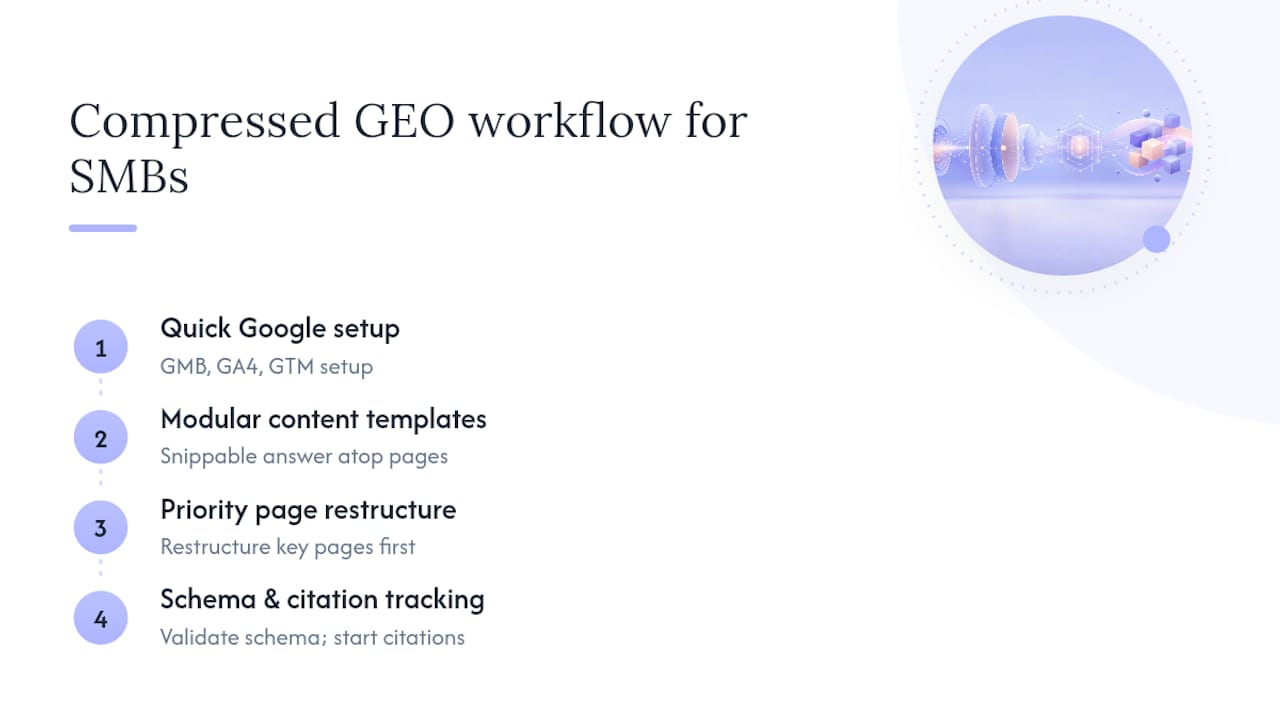
Small consultancies and local service businesses rarely have a content team large enough to run a full GEO sprint on their own, which is exactly the gap Tech Business Development works in. The approach mirrors the workflow above but compressed for teams without dedicated writers or developers: fast setup of the Google services (GMB, GA4, GTM) that make a site eligible for indexing in the first place, modular content templates that put a snippable answer at the top of every key page, and reporting dashboards that track AI-referral traffic alongside conversions.
The practical value for a small business owner is speed. Instead of a months-long content overhaul, the priority pages get restructured first, schema gets checked, and citation tracking starts within the same engagement, rather than as a separate project billed later.
What actually moves the needle in GEO?
The research keeps pointing at the same conclusion, and it’s less exciting than most agencies want to admit: the winning move isn’t a clever new tactic, it’s disciplined justification. Adding real citations and statistics to content that’s already good outperforms most “AI-first” rewrites, because generative engines are pattern-matching for verifiable, attributable claims, not creativity.
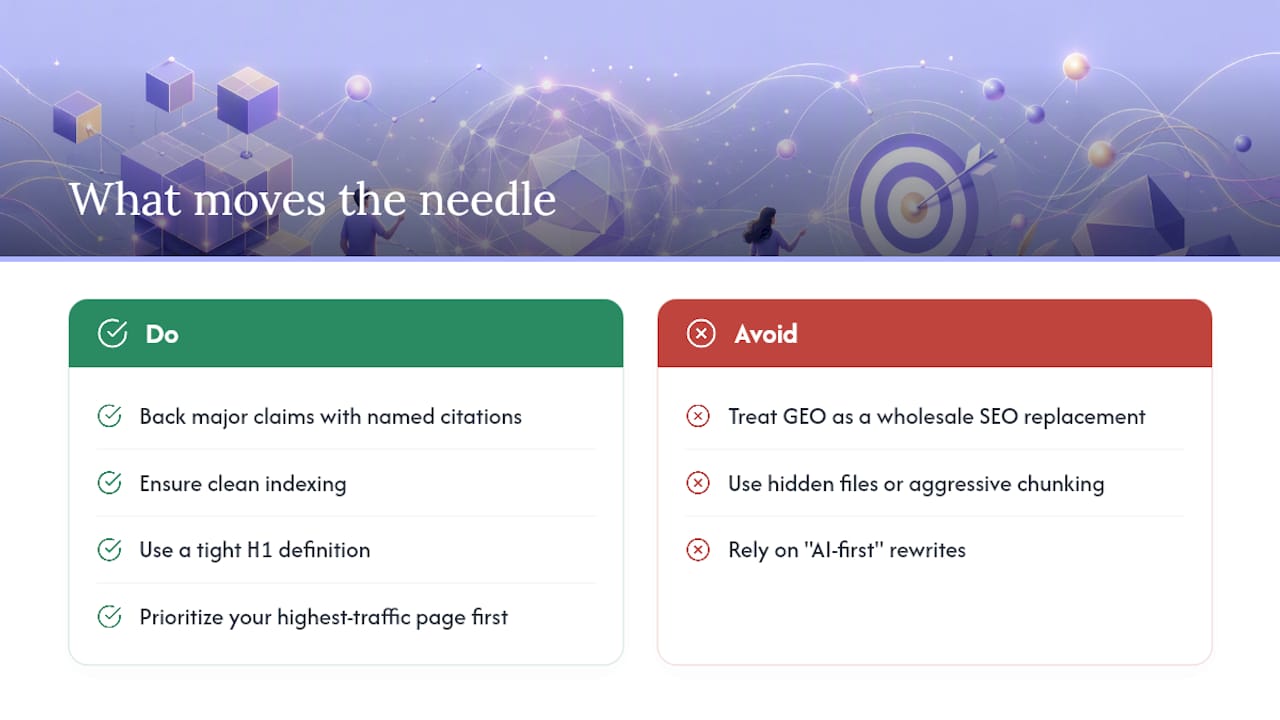
Where conventional advice goes wrong is treating GEO as a wholesale replacement for SEO fundamentals, or worse, as a set of tricks like hidden files and aggressive chunking. Google has already said those tactics don’t move the needle. What does move it is unglamorous: clean indexing, a tight definition under the H1, and a habit of backing every major claim with a number or a quote that has a name attached to it.
If you’re a marketer with limited bandwidth, prioritize your highest-traffic page first. Restructure it, add one strong citation, and measure the citation rate before and after. That single experiment will teach your team more about GEO than reading ten more guides on the topic.
— Shayan Shirvani
Ready to make your content AI-citable?
A specialized consultancy can build the technical foundation GEO depends on, provide Google services setup, website builds, and structured content more quickly than traditional agencies often do. If you’ve read this far and realized your site might not even be indexed cleanly enough to be considered for an AI answer, that’s the first problem worth solving before any content rewrite.

For small businesses and local service providers, the value often lies in having one team handle the Google services setup, site structure, and analytics dashboard together, improving coordination across tasks. You can also read a partner breakdown of GEO strategy for a second perspective on where AI search is headed.
Start by requesting a technical audit through Tech Business Development to see exactly where your priority pages stand on indexing, schema, and citation-readiness before you invest another dollar in content.
Sources
- Optimizing your website for generative AI features on Google Search
- A Multi-Factor Brand-Recognition Audit for AI Answer Engines
- Optimizing your content for inclusion in AI search answers
Recommended