Automate competitor analysis reporting in 2026


Automated competitor analysis reporting is the practice of using software and AI to continuously collect, classify, and deliver structured intelligence about your competitors without manual effort. Marketing professionals and business owners who automate competitor analysis reporting replace hours of weekly research with scheduled digests, real-time alerts, and AI-generated summaries that arrive in their inbox or Slack channel before the morning stand-up. The industry standard for competitive intelligence cadence combines weekly tactical digests with quarterly deep-dive reports, a structure that balances speed with strategic depth. Techbusinessdevelopment works with marketing teams to build exactly these kinds of automated workflows, cutting operational overhead by up to 50%.
What tools and data sources do you need to automate competitor reports?
The foundation of any automated competitor reporting system is a well-chosen set of data sources. Pricing pages, product changelogs, careers listings, review platforms, and social activity each reveal a different layer of competitor behaviour. Monitoring all of them manually is not realistic. Automation makes it possible.
Data source categories and their purpose
Data sourceWhat it revealsMonitoring cadencePricing pagesPrice changes, tier restructuringDailyCareers listingsHiring signals, strategic directionWeeklyProduct changelogsFeature releases, deprecationsDailyReview platformsCustomer sentiment shiftsWeeklySocial activityMessaging and campaign pivotsDaily
Tools fall into three broad categories: monitoring platforms, web scraping tools, and AI synthesis platforms. Monitoring platforms watch specific URLs and trigger alerts when content changes. Competitive intelligence stacks that combine aggregated intelligence platforms with custom scraping tools capture the widest range of competitor signals. AI synthesis platforms then take that raw data and turn it into readable, prioritised summaries.

Monitoring frequency matters as much as tool selection. Alert times under 5 minutes are achievable for high-severity changes when you configure check frequencies between 1 minute and 3 hours. That speed is the difference between reacting to a competitor’s pricing change before your sales team fields calls about it and finding out a week later.
Pro Tip: Start by monitoring three to five pages per competitor rather than their entire site. Pricing, homepage, and the primary product page give you the highest signal-to-noise ratio at the lowest cost.
Pricing for automated monitoring starts at $0 per month for basic plans and scales to enterprise tiers around $2,000 per month. Most marketing teams find that a mid-tier plan around $25 per month covers the core use case well.
How do you set up an AI-driven workflow for competitive insights?
Raw data is not intelligence. An AI-driven synthesis layer is what separates a useful automated competitor reporting system from a noisy alert feed. AI-powered tools can analyse over 100 data points covering pricing, messaging, and features, and generate structured, sourced reports in under 2 minutes. That speed is only valuable if the output is accurate and filtered.
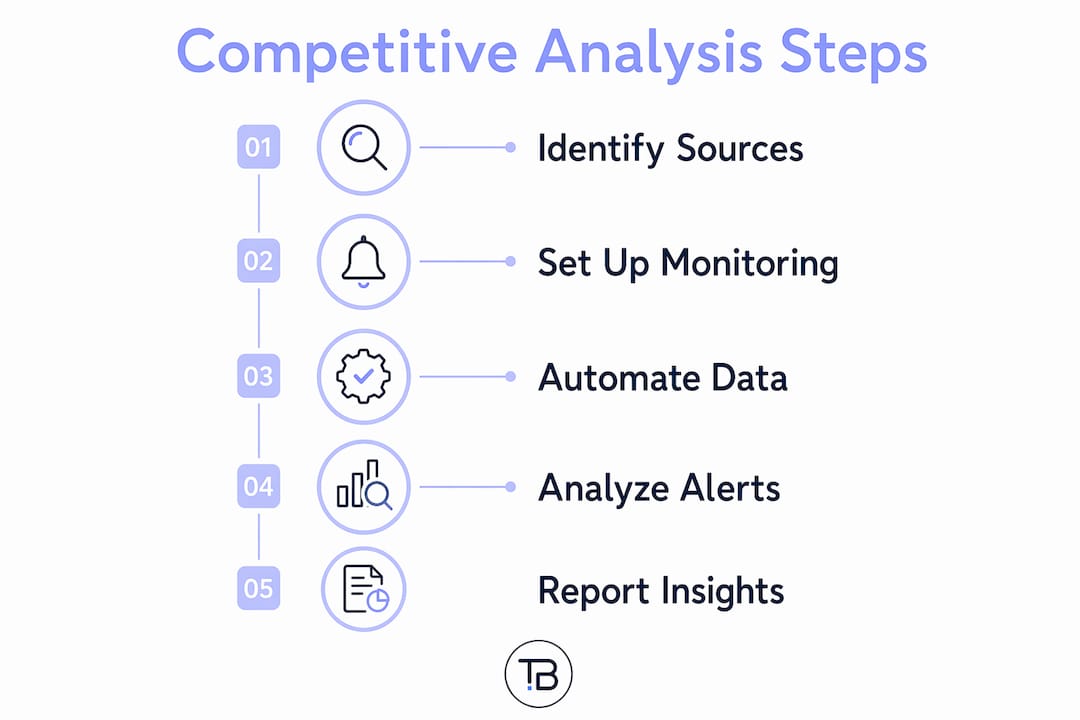
Setting up the AI layer requires deliberate configuration. Follow these steps to build a workflow that surfaces signals rather than noise.
Pro Tip: False positives erode trust in your reporting system faster than anything else. If your team starts ignoring alerts because they are rarely meaningful, the whole system fails. Tune aggressively in the first month.
Modern web scraping for competitor data also requires technical care. Extracting reliable data from dynamic web frameworks means targeting hydration JSON islands in frameworks like Next.js rather than fragile DOM selectors. This approach produces far more reliable scrapers that do not break every time a competitor updates their front-end code.
What is the right reporting cadence for automated competitor analysis?
The dual cadence approach is the most effective structure for automated competitor reporting. Weekly digests handle tactical updates. Quarterly reports handle strategic analysis. Each serves a different audience and a different decision-making timeframe.
Weekly digests should take no more than 5–10 minutes to read. They cover changes detected during the week, linked evidence, AI interpretation of what each change means, and suggested actions. The goal is to keep your team informed without requiring them to do any research themselves. Delivering reports through multiple channels, including email, Slack, Microsoft Teams, and webhooks, ensures that the right people see the right information in the tools they already use.
Quarterly deep-dive reports serve a different purpose. They synthesise patterns across three months of weekly data, identify strategic trends, and produce recommendations for product positioning, pricing strategy, and messaging. These reports require more AI processing time but less human effort than a manually produced quarterly review.
Best practices for reporting cadence
Pro Tip: Route weekly digests to a dedicated Slack channel rather than individual inboxes. A shared channel creates a searchable archive and lets team members comment on findings in context.
What are the common challenges in competitor analysis automation?
Automation does not eliminate problems. It shifts them. The challenges in automated competitor reporting are different from the challenges in manual research, but they are just as real.
Data quality is the most common issue. Scrapers break when competitors update their site architecture. Monitoring tools miss changes on pages that load content dynamically. Regular audits of your data sources catch these gaps before they create blind spots in your reporting.
False positives erode team confidence. When alerts fire for irrelevant changes, teams start ignoring them. The fix is iterative tuning of your classification rules, not a one-time setup.
Integration complexity grows as your stack expands. Connecting monitoring tools, AI synthesis platforms, and delivery channels requires either technical resources or a managed service. Human review focuses on interpreting AI-synthesised intelligence rather than managing the plumbing, which is the right division of labour.
Scaling monitoring across dozens of competitors and hundreds of pages increases cost and noise simultaneously. The solution is prioritisation. Track fewer pages per competitor, but track the right ones.
Pro Tip: Set a quarterly calendar reminder to review your entire monitoring setup. Tools change, competitors restructure their sites, and your strategic priorities shift. A system that was well-tuned six months ago may be producing stale intelligence today.
Key takeaways
Automated competitor reporting delivers consistent, timely intelligence only when the underlying system combines the right data sources, AI-driven classification, and a disciplined reporting cadence.
PointDetailsStart with focused data sourcesMonitor pricing, careers, and product pages first for the highest signal-to-noise ratio.Use AI to classify, not just collectConfigure AI to sort changes by severity so alerts reach the right people at the right time.Apply a dual cadenceWeekly digests handle tactical updates; quarterly reports handle strategic analysis.Tune filters continuouslyFalse positives destroy team trust; review classification rules monthly in the first quarter.Automate delivery across channelsRoute reports through email, Slack, or webhooks so teams receive intelligence in their existing tools.
Why most teams underestimate what automation actually requires
I have seen marketing teams stand up a monitoring tool, celebrate for a week, and then quietly stop checking it by week three. The alerts were too frequent, too vague, or both. The problem was never the tool. It was the absence of a classification layer and a clear owner for the output.
The teams that get real value from automated competitor reporting treat it like a product, not a project. They assign ownership, iterate on filters, and hold a monthly review of what the system is actually surfacing. They also resist the temptation to monitor everything. Focused monitoring of five competitors and fifteen pages produces better intelligence than broad monitoring of fifty competitors and five hundred pages.
AI is genuinely changing what is possible here. The ability to generate structured competitor reports in under 2 minutes would have required a full-time analyst two years ago. But AI does not replace strategic judgement. It replaces the labour of gathering and organising data. The interpretation, the “so what,” still requires a human who understands your market, your customers, and your positioning. The best automated systems I have seen are the ones where automation handles 80% of the work and a sharp analyst handles the 20% that actually drives decisions.
How Tech business development can build your reporting system
Tech business development specialises in building workflow automation systems that replace manual processes with structured, AI-driven pipelines. For marketing teams and business owners who need to move faster on competitive intelligence, that means designing monitoring setups, configuring AI classification layers, and connecting report delivery to the tools your team already uses.

The automation and IT services at Tech business development cover the full stack: data source selection, scraper configuration, AI synthesis setup, and multi-channel report delivery. Clients in marketing, logistics, and technology have used these workflows to cut manual research time significantly while receiving more consistent and reliable competitive intelligence. If you want a system that runs itself and surfaces the signals that matter, Techbusinessdevelopment is built for exactly that.
FAQ
What is automated competitor analysis reporting?
Automated competitor analysis reporting is the use of software and AI to continuously monitor competitor activity, classify changes by significance, and deliver structured intelligence reports without manual effort. It replaces ad hoc research with scheduled digests and real-time alerts.
How often should automated competitor reports be delivered?
The most effective cadence combines weekly tactical digests with quarterly strategic deep-dive reports. Weekly digests take 5–10 minutes to read and cover recent changes, while quarterly reports identify longer-term trends and strategic shifts.
What data sources should I monitor for competitor analysis?
Pricing pages, product changelogs, careers listings, review platforms, and social activity are the highest-value sources. Monitoring these five categories covers pricing strategy, product direction, hiring signals, customer sentiment, and messaging pivots.
How do I avoid false positives in automated competitor alerts?
Configure your AI classification layer to filter out low-value changes like footer updates, rotating testimonials, and cookie banner variations. Classifying changes by severity and routing only major changes to immediate alerts reduces noise significantly.
What does automated competitor monitoring cost?
Pricing starts at $0 per month for basic plans and scales to around $2,000 per month for enterprise-level monitoring. Most marketing teams find mid-tier plans around $25 per month sufficient for tracking five to ten competitors across their most important pages.